


Page 492 - Basic Electrical Engineering
P. 492
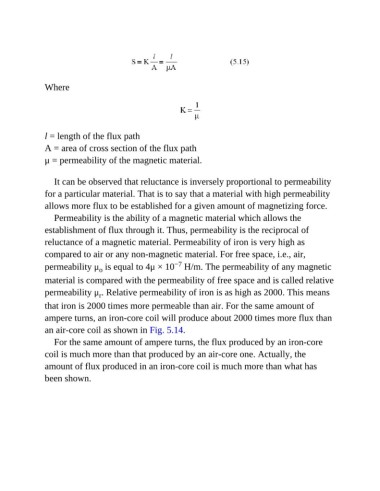
Where


               l = length of the flux path
               A = area of cross section of the flux path

               μ = permeability of the magnetic material.


                  It can be observed that reluctance is inversely proportional to permeability
               for a particular material. That is to say that a material with high permeability

               allows more flux to be established for a given amount of magnetizing force.
                  Permeability is the ability of a magnetic material which allows the

               establishment of flux through it. Thus, permeability is the reciprocal of
               reluctance of a magnetic material. Permeability of iron is very high as
               compared to air or any non-magnetic material. For free space, i.e., air,

                                                         −7
               permeability μ  is equal to 4μ × 10  H/m. The permeability of any magnetic
                                 o
               material is compared with the permeability of free space and is called relative
               permeability μ . Relative permeability of iron is as high as 2000. This means
                                 r
               that iron is 2000 times more permeable than air. For the same amount of
               ampere turns, an iron-core coil will produce about 2000 times more flux than

               an air-core coil as shown in Fig. 5.14.
                  For the same amount of ampere turns, the flux produced by an iron-core

               coil is much more than that produced by an air-core one. Actually, the
               amount of flux produced in an iron-core coil is much more than what has

               been shown.

