


Page 491 - Basic Electrical Engineering
P. 491
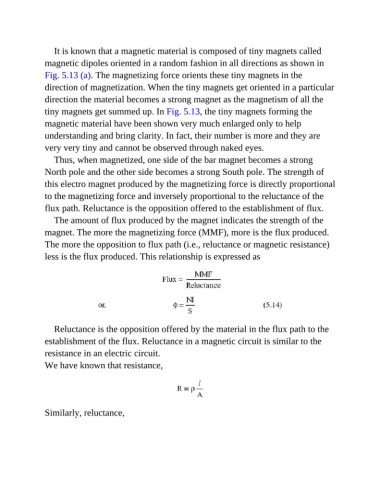
It is known that a magnetic material is composed of tiny magnets called
               magnetic dipoles oriented in a random fashion in all directions as shown in
               Fig. 5.13 (a). The magnetizing force orients these tiny magnets in the

               direction of magnetization. When the tiny magnets get oriented in a particular
               direction the material becomes a strong magnet as the magnetism of all the

               tiny magnets get summed up. In Fig. 5.13, the tiny magnets forming the
               magnetic material have been shown very much enlarged only to help

               understanding and bring clarity. In fact, their number is more and they are
               very very tiny and cannot be observed through naked eyes.

                  Thus, when magnetized, one side of the bar magnet becomes a strong
               North pole and the other side becomes a strong South pole. The strength of
               this electro magnet produced by the magnetizing force is directly proportional

               to the magnetizing force and inversely proportional to the reluctance of the
               flux path. Reluctance is the opposition offered to the establishment of flux.

                  The amount of flux produced by the magnet indicates the strength of the
               magnet. The more the magnetizing force (MMF), more is the flux produced.

               The more the opposition to flux path (i.e., reluctance or magnetic resistance)
               less is the flux produced. This relationship is expressed as


                  Reluctance is the opposition offered by the material in the flux path to the
               establishment of the flux. Reluctance in a magnetic circuit is similar to the
               resistance in an electric circuit.

               We have known that resistance,


               Similarly, reluctance,

