


Page 569 - Basic Electrical Engineering
P. 569
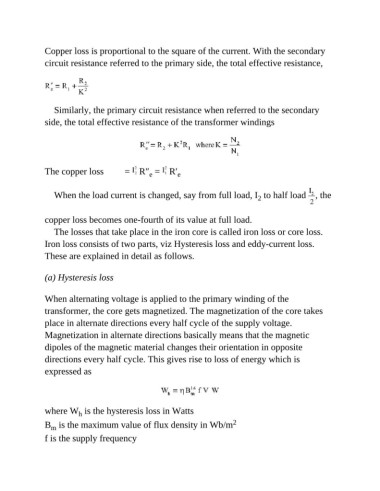
Copper loss is proportional to the square of the current. With the secondary
               circuit resistance referred to the primary side, the total effective resistance,


                  Similarly, the primary circuit resistance when referred to the secondary
               side, the total effective resistance of the transformer windings


               The copper loss         =   R″  =   R′     e
                                                 e


                  When the load current is changed, say from full load, I  to half load  , the
                                                                                    2


               copper loss becomes one-fourth of its value at full load.
                  The losses that take place in the iron core is called iron loss or core loss.
               Iron loss consists of two parts, viz Hysteresis loss and eddy-current loss.

               These are explained in detail as follows.


               (a) Hysteresis loss


               When alternating voltage is applied to the primary winding of the
               transformer, the core gets magnetized. The magnetization of the core takes
               place in alternate directions every half cycle of the supply voltage.

               Magnetization in alternate directions basically means that the magnetic
               dipoles of the magnetic material changes their orientation in opposite

               directions every half cycle. This gives rise to loss of energy which is
               expressed as


               where W  is the hysteresis loss in Watts
                          h
               B  is the maximum value of flux density in Wb/m              2
                 m
               f is the supply frequency

