


Page 567 - Basic Electrical Engineering
P. 567
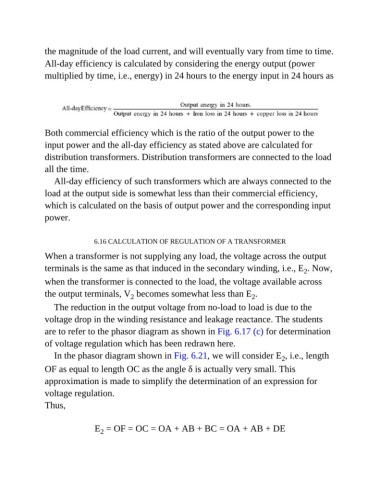
the magnitude of the load current, and will eventually vary from time to time.
               All-day efficiency is calculated by considering the energy output (power
               multiplied by time, i.e., energy) in 24 hours to the energy input in 24 hours as


               Both commercial efficiency which is the ratio of the output power to the
               input power and the all-day efficiency as stated above are calculated for

               distribution transformers. Distribution transformers are connected to the load
               all the time.

                  All-day efficiency of such transformers which are always connected to the
               load at the output side is somewhat less than their commercial efficiency,

               which is calculated on the basis of output power and the corresponding input
               power.


                               6.16 CALCULATION OF REGULATION OF A TRANSFORMER

               When a transformer is not supplying any load, the voltage across the output
               terminals is the same as that induced in the secondary winding, i.e., E . Now,
                                                                                                   2
               when the transformer is connected to the load, the voltage available across
               the output terminals, V  becomes somewhat less than E .
                                           2
                                                                                  2
                  The reduction in the output voltage from no-load to load is due to the

               voltage drop in the winding resistance and leakage reactance. The students
               are to refer to the phasor diagram as shown in Fig. 6.17 (c) for determination
               of voltage regulation which has been redrawn here.

                  In the phasor diagram shown in Fig. 6.21, we will consider E , i.e., length
                                                                                            2
               OF as equal to length OC as the angle δ is actually very small. This
               approximation is made to simplify the determination of an expression for

               voltage regulation.
               Thus,


                               E  = OF = OC = OA + AB + BC = OA + AB + DE
                                 2

