


Page 628 - Basic Electrical Engineering
P. 628
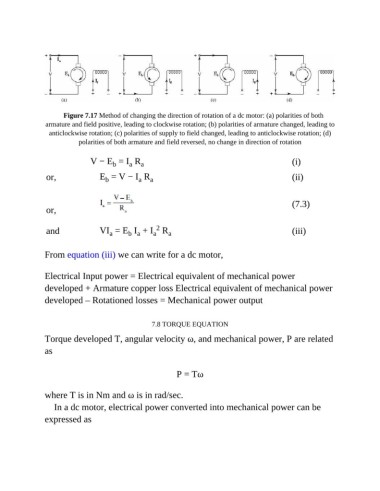
Figure 7.17 Method of changing the direction of rotation of a dc motor: (a) polarities of both
                armature and field positive, leading to clockwise rotation; (b) polarities of armature changed, leading to
                 anticlockwise rotation; (c) polarities of supply to field changed, leading to anticlockwise rotation; (d)
                          polarities of both armature and field reversed, no change in direction of rotation


                              V − E  = I  R   a                                                (i)
                                           a
                                     b
                or,              E  = V − I  R   a                                             (ii)
                                   b
                                              a

                                                                                               (7.3)
                or,

                                                   2
                and              VI  = E  I  + I  R    a                                       (iii)
                                    a
                                          b a
                                                  a
               From equation (iii) we can write for a dc motor,


               Electrical Input power = Electrical equivalent of mechanical power
               developed + Armature copper loss Electrical equivalent of mechanical power

               developed – Rotationed losses = Mechanical power output


                                                  7.8 TORQUE EQUATION

               Torque developed T, angular velocity ω, and mechanical power, P are related
               as


                                                          P = Tω


               where T is in Nm and ω is in rad/sec.
                  In a dc motor, electrical power converted into mechanical power can be

               expressed as

