


Page 632 - Basic Electrical Engineering
P. 632
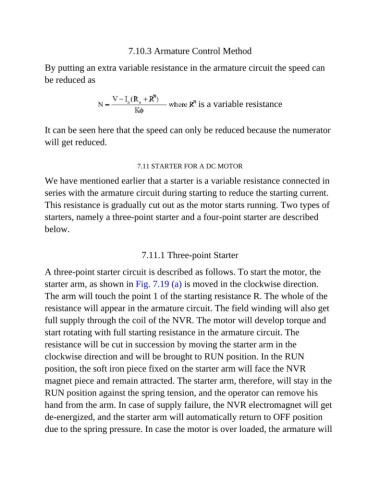
7.10.3 Armature Control Method

               By putting an extra variable resistance in the armature circuit the speed can
               be reduced as


                                                                 is a variable resistance


               It can be seen here that the speed can only be reduced because the numerator
               will get reduced.


                                             7.11 STARTER FOR A DC MOTOR

               We have mentioned earlier that a starter is a variable resistance connected in
               series with the armature circuit during starting to reduce the starting current.

               This resistance is gradually cut out as the motor starts running. Two types of
               starters, namely a three-point starter and a four-point starter are described

               below.


                                               7.11.1 Three-point Starter

               A three-point starter circuit is described as follows. To start the motor, the
               starter arm, as shown in Fig. 7.19 (a) is moved in the clockwise direction.

               The arm will touch the point 1 of the starting resistance R. The whole of the
               resistance will appear in the armature circuit. The field winding will also get

               full supply through the coil of the NVR. The motor will develop torque and
               start rotating with full starting resistance in the armature circuit. The

               resistance will be cut in succession by moving the starter arm in the
               clockwise direction and will be brought to RUN position. In the RUN

               position, the soft iron piece fixed on the starter arm will face the NVR
               magnet piece and remain attracted. The starter arm, therefore, will stay in the
               RUN position against the spring tension, and the operator can remove his

               hand from the arm. In case of supply failure, the NVR electromagnet will get
               de-energized, and the starter arm will automatically return to OFF position

               due to the spring pressure. In case the motor is over loaded, the armature will

