


Page 630 - Basic Electrical Engineering
P. 630
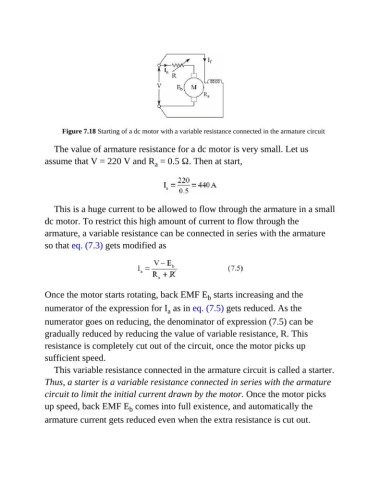
Figure 7.18 Starting of a dc motor with a variable resistance connected in the armature circuit

                  The value of armature resistance for a dc motor is very small. Let us

               assume that V = 220 V and R  = 0.5 Ω. Then at start,
                                                   a


                  This is a huge current to be allowed to flow through the armature in a small
               dc motor. To restrict this high amount of current to flow through the
               armature, a variable resistance can be connected in series with the armature

               so that eq. (7.3) gets modified as


               Once the motor starts rotating, back EMF E  starts increasing and the
                                                                    b
               numerator of the expression for I  as in eq. (7.5) gets reduced. As the
                                                       a
               numerator goes on reducing, the denominator of expression (7.5) can be

               gradually reduced by reducing the value of variable resistance, R. This
               resistance is completely cut out of the circuit, once the motor picks up

               sufficient speed.
                  This variable resistance connected in the armature circuit is called a starter.
               Thus, a starter is a variable resistance connected in series with the armature

               circuit to limit the initial current drawn by the motor. Once the motor picks
               up speed, back EMF E  comes into full existence, and automatically the
                                           b
               armature current gets reduced even when the extra resistance is cut out.

