


Page 685 - Basic Electrical Engineering
P. 685
2
               power gets lost in the stator windings as I  R loss, in the stator core as core
                                                                          2
               loss. Similarly, power is also lost in the rotor as I  R loss and core loss. When
               the rotor rotates against the wind (air) friction, power is lost as windage loss
               and bearing-friction loss and brush-friction loss (in case of slip-ring motors

               only). Iron loss is the sum of hysteresis loss and eddy curent loss. Hysteresis
               and eddy current losses depend upon the frequency and flux density. The
               frequency of the induced EMF and current in the rotor is very small (f  = sf).
                                                                                                   r
               Therefore, rotor core loss is considered negligible. Stator core loss is constant
                                                                                                         2
               at all loads since the supply voltage and frequency are normally constant. I R
               losses in the stator and rotor windings are variable, i.e., they vary with change

               of load (i.e., load current).
                  Thus, the various losses are

                   a.  stator copper loss;
                   b.  rotor copper loss;
                   c.  iron loss in stator;
                   d.  iron loss in the rotor (very small);
                   e.  air-friction loss due to rotation of the rotor;
                   f.  bearing-friction loss;
                   g.  brush- and slip-ring-friction loss (in case of slip-ring motors only).


                                               8.8 POWER FLOW DIAGRAM

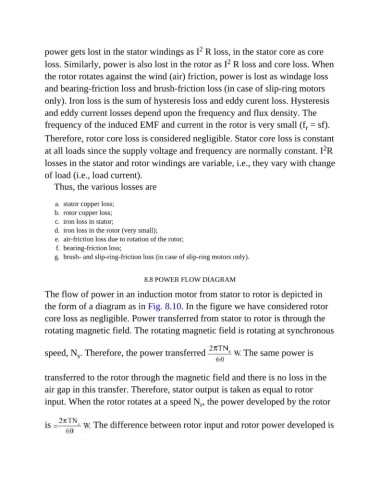
               The flow of power in an induction motor from stator to rotor is depicted in
               the form of a diagram as in Fig. 8.10. In the figure we have considered rotor

               core loss as negligible. Power transferred from stator to rotor is through the
               rotating magnetic field. The rotating magnetic field is rotating at synchronous


               speed, N . Therefore, the power transferred                      The same power is
                          s


               transferred to the rotor through the magnetic field and there is no loss in the

               air gap in this transfer. Therefore, stator output is taken as equal to rotor
               input. When the rotor rotates at a speed N , the power developed by the rotor
                                                                 r


               is              The difference between rotor input and rotor power developed is

