


Page 684 - Basic Electrical Engineering
P. 684
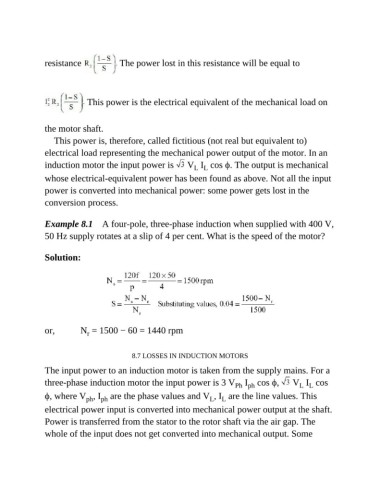
resistance               The power lost in this resistance will be equal to


                             This power is the electrical equivalent of the mechanical load on


               the motor shaft.

                  This power is, therefore, called fictitious (not real but equivalent to)
               electrical load representing the mechanical power output of the motor. In an
               induction motor the input power is   V  I  cos ϕ. The output is mechanical
                                                               L L
               whose electrical-equivalent power has been found as above. Not all the input

               power is converted into mechanical power: some power gets lost in the
               conversion process.


               Example 8.1    A four-pole, three-phase induction when supplied with 400 V,

               50 Hz supply rotates at a slip of 4 per cent. What is the speed of the motor?


               Solution:


               or,           N  = 1500 − 60 = 1440 rpm
                             r


                                           8.7 LOSSES IN INDUCTION MOTORS

               The input power to an induction motor is taken from the supply mains. For a
               three-phase induction motor the input power is 3 V  I  cos ϕ,   V  I  cos
                                                                                                 L L
                                                                             Ph ph
               ϕ, where V , I  are the phase values and V , I  are the line values. This
                                                                        L
                                                                     L
                                 ph
                             ph
               electrical power input is converted into mechanical power output at the shaft.
               Power is transferred from the stator to the rotor shaft via the air gap. The
               whole of the input does not get converted into mechanical output. Some

