


Page 679 - Basic Electrical Engineering
P. 679
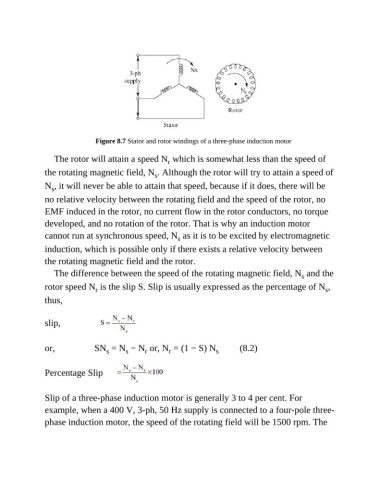
Figure 8.7 Stator and rotor windings of a three-phase induction motor

                  The rotor will attain a speed N  which is somewhat less than the speed of
                                                       r
               the rotating magnetic field, N . Although the rotor will try to attain a speed of
                                                   s
               N , it will never be able to attain that speed, because if it does, there will be
                  s
               no relative velocity between the rotating field and the speed of the rotor, no
               EMF induced in the rotor, no current flow in the rotor conductors, no torque
               developed, and no rotation of the rotor. That is why an induction motor

               cannot run at synchronous speed, N  as it is to be excited by electromagnetic
                                                          s
               induction, which is possible only if there exists a relative velocity between
               the rotating magnetic field and the rotor.
                  The difference between the speed of the rotating magnetic field, N  and the
                                                                                                  s
               rotor speed N  is the slip S. Slip is usually expressed as the percentage of N ,
                                r
                                                                                                          s
               thus,


               slip,


               or,                 SN  = N  − N  or, N  = (1 − S) N          (8.2)
                                                                       s
                                                       r
                                   s
                                         s
                                                r
               Percentage Slip


               Slip of a three-phase induction motor is generally 3 to 4 per cent. For
               example, when a 400 V, 3-ph, 50 Hz supply is connected to a four-pole three-
               phase induction motor, the speed of the rotating field will be 1500 rpm. The

