


Page 678 - Basic Electrical Engineering
P. 678
squirrel-cage winding; or, through extra resistance inserted in the rotor circuit
               as in the case of slip-ring motors. The rotor gets excited due to
               electromagnetic induction. We will now study the principle of working of a

               three-phase induction motor.


                                               8.5 PRINCIPLE OF WORKING

               In a three-phase induction motor, the stator is wound with a three-phase
               winding for P number of poles. The poles for which the winding is made

               could be 2, 4, 6, 8, … etc. The rotor which is placed inside the stator is either
               squirrel-cage type or slip-ring type. In both cases, current flowing through the
               three-phase stator winding produces a rotating magnetic field which will be

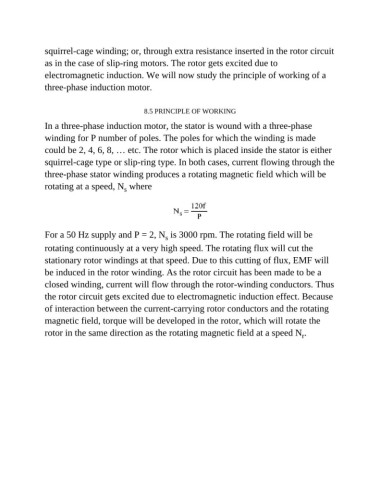
               rotating at a speed, N  where
                                         s


               For a 50 Hz supply and P = 2, N  is 3000 rpm. The rotating field will be
                                                      s
               rotating continuously at a very high speed. The rotating flux will cut the

               stationary rotor windings at that speed. Due to this cutting of flux, EMF will
               be induced in the rotor winding. As the rotor circuit has been made to be a

               closed winding, current will flow through the rotor-winding conductors. Thus
               the rotor circuit gets excited due to electromagnetic induction effect. Because

               of interaction between the current-carrying rotor conductors and the rotating
               magnetic field, torque will be developed in the rotor, which will rotate the
               rotor in the same direction as the rotating magnetic field at a speed N .
                                                                                                  r

