


Page 675 - Basic Electrical Engineering
P. 675
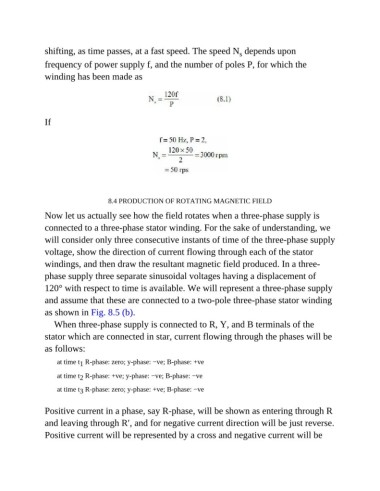
shifting, as time passes, at a fast speed. The speed N  depends upon
                                                                              s
               frequency of power supply f, and the number of poles P, for which the

               winding has been made as


               If


                                    8.4 PRODUCTION OF ROTATING MAGNETIC FIELD

               Now let us actually see how the field rotates when a three-phase supply is
               connected to a three-phase stator winding. For the sake of understanding, we

               will consider only three consecutive instants of time of the three-phase supply
               voltage, show the direction of current flowing through each of the stator
               windings, and then draw the resultant magnetic field produced. In a three-

               phase supply three separate sinusoidal voltages having a displacement of
               120° with respect to time is available. We will represent a three-phase supply

               and assume that these are connected to a two-pole three-phase stator winding
               as shown in Fig. 8.5 (b).

                  When three-phase supply is connected to R, Y, and B terminals of the
               stator which are connected in star, current flowing through the phases will be

               as follows:
                     at time t  R-phase: zero; y-phase: −ve; B-phase: +ve
                           1
                     at time t  R-phase: +ve; y-phase: −ve; B-phase: −ve
                           2
                     at time t  R-phase: zero; y-phase: +ve; B-phase: −ve
                           3

               Positive current in a phase, say R-phase, will be shown as entering through R

               and leaving through R′, and for negative current direction will be just reverse.
               Positive current will be represented by a cross and negative current will be

