


Page 677 - Basic Electrical Engineering
P. 677
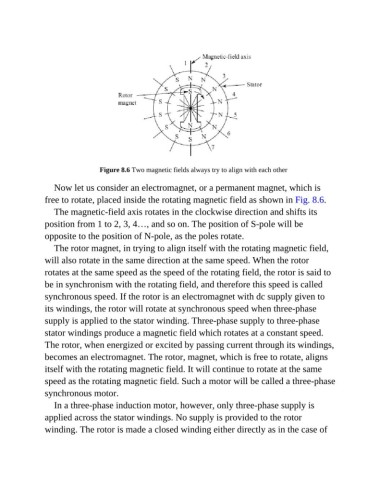
Figure 8.6 Two magnetic fields always try to align with each other

                  Now let us consider an electromagnet, or a permanent magnet, which is

               free to rotate, placed inside the rotating magnetic field as shown in Fig. 8.6.
                  The magnetic-field axis rotates in the clockwise direction and shifts its
               position from 1 to 2, 3, 4…, and so on. The position of S-pole will be

               opposite to the position of N-pole, as the poles rotate.
                  The rotor magnet, in trying to align itself with the rotating magnetic field,

               will also rotate in the same direction at the same speed. When the rotor
               rotates at the same speed as the speed of the rotating field, the rotor is said to

               be in synchronism with the rotating field, and therefore this speed is called
               synchronous speed. If the rotor is an electromagnet with dc supply given to

               its windings, the rotor will rotate at synchronous speed when three-phase
               supply is applied to the stator winding. Three-phase supply to three-phase
               stator windings produce a magnetic field which rotates at a constant speed.

               The rotor, when energized or excited by passing current through its windings,
               becomes an electromagnet. The rotor, magnet, which is free to rotate, aligns

               itself with the rotating magnetic field. It will continue to rotate at the same
               speed as the rotating magnetic field. Such a motor will be called a three-phase

               synchronous motor.
                  In a three-phase induction motor, however, only three-phase supply is

               applied across the stator windings. No supply is provided to the rotor
               winding. The rotor is made a closed winding either directly as in the case of

