


Page 698 - Basic Electrical Engineering
P. 698
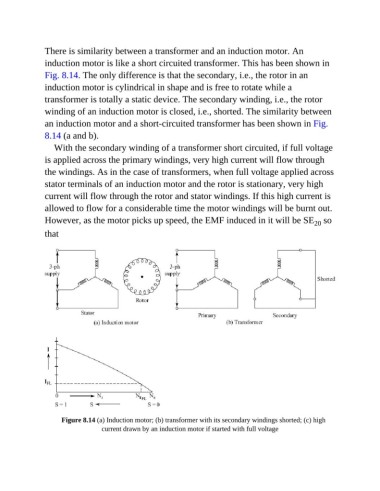
There is similarity between a transformer and an induction motor. An
               induction motor is like a short circuited transformer. This has been shown in
               Fig. 8.14. The only difference is that the secondary, i.e., the rotor in an

               induction motor is cylindrical in shape and is free to rotate while a
               transformer is totally a static device. The secondary winding, i.e., the rotor

               winding of an induction motor is closed, i.e., shorted. The similarity between
               an induction motor and a short-circuited transformer has been shown in Fig.

               8.14 (a and b).
                  With the secondary winding of a transformer short circuited, if full voltage

               is applied across the primary windings, very high current will flow through
               the windings. As in the case of transformers, when full voltage applied across
               stator terminals of an induction motor and the rotor is stationary, very high

               current will flow through the rotor and stator windings. If this high current is
               allowed to flow for a considerable time the motor windings will be burnt out.

               However, as the motor picks up speed, the EMF induced in it will be SE  so
                                                                                                      20
               that


                     Figure 8.14 (a) Induction motor; (b) transformer with its secondary windings shorted; (c) high
                                  current drawn by an induction motor if started with full voltage

