


Page 699 - Basic Electrical Engineering
P. 699
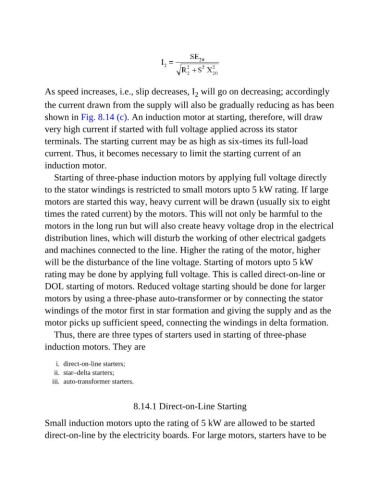
As speed increases, i.e., slip decreases, I  will go on decreasing; accordingly
                                                                2
               the current drawn from the supply will also be gradually reducing as has been

               shown in Fig. 8.14 (c). An induction motor at starting, therefore, will draw
               very high current if started with full voltage applied across its stator

               terminals. The starting current may be as high as six-times its full-load
               current. Thus, it becomes necessary to limit the starting current of an

               induction motor.
                  Starting of three-phase induction motors by applying full voltage directly

               to the stator windings is restricted to small motors upto 5 kW rating. If large
               motors are started this way, heavy current will be drawn (usually six to eight
               times the rated current) by the motors. This will not only be harmful to the

               motors in the long run but will also create heavy voltage drop in the electrical
               distribution lines, which will disturb the working of other electrical gadgets

               and machines connected to the line. Higher the rating of the motor, higher
               will be the disturbance of the line voltage. Starting of motors upto 5 kW

               rating may be done by applying full voltage. This is called direct-on-line or
               DOL starting of motors. Reduced voltage starting should be done for larger

               motors by using a three-phase auto-transformer or by connecting the stator
               windings of the motor first in star formation and giving the supply and as the
               motor picks up sufficient speed, connecting the windings in delta formation.

                  Thus, there are three types of starters used in starting of three-phase
               induction motors. They are


                   i.  direct-on-line starters;
                  ii.  star–delta starters;
                  iii.  auto-transformer starters.


                                            8.14.1 Direct-on-Line Starting


               Small induction motors upto the rating of 5 kW are allowed to be started
               direct-on-line by the electricity boards. For large motors, starters have to be

