


Page 705 - Basic Electrical Engineering
P. 705
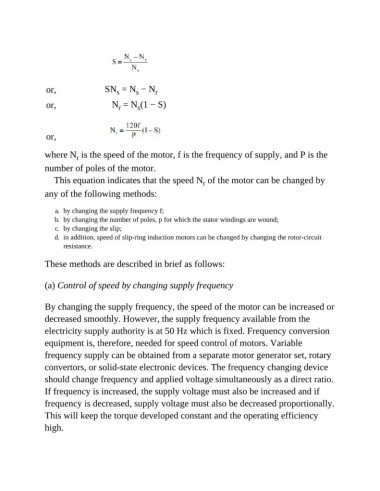
or,                SN  = N  − N    r
                                       s
                                             s
                or,                   N  = N (1 − S)
                                       r
                                             s


                or,

               where N  is the speed of the motor, f is the frequency of supply, and P is the
                          r
               number of poles of the motor.

                  This equation indicates that the speed N  of the motor can be changed by
                                                                  r
               any of the following methods:


                   a.  by changing the supply frequency f;
                   b.  by changing the number of poles, p for which the stator windings are wound;
                   c.  by changing the slip;
                   d.  in addition, speed of slip-ring induction motors can be changed by changing the rotor-circuit
                     resistance.

               These methods are described in brief as follows:


               (a) Control of speed by changing supply frequency


               By changing the supply frequency, the speed of the motor can be increased or

               decreased smoothly. However, the supply frequency available from the
               electricity supply authority is at 50 Hz which is fixed. Frequency conversion
               equipment is, therefore, needed for speed control of motors. Variable

               frequency supply can be obtained from a separate motor generator set, rotary
               convertors, or solid-state electronic devices. The frequency changing device

               should change frequency and applied voltage simultaneously as a direct ratio.
               If frequency is increased, the supply voltage must also be increased and if

               frequency is decreased, supply voltage must also be decreased proportionally.
               This will keep the torque developed constant and the operating efficiency

               high.

