


Page 708 - Basic Electrical Engineering
P. 708
Efficiency of an induction motor can be determined by loading the motor and
               measuring the mechanical output and the electrical input. By converting the
               input and output in either electrical unit or in mechanical unit, the efficiency

               of the motor can be determined by taking the ratio of output and input. Small
               induction motors can be tested by this method where it is possible to load the

               machine in the laboratory.
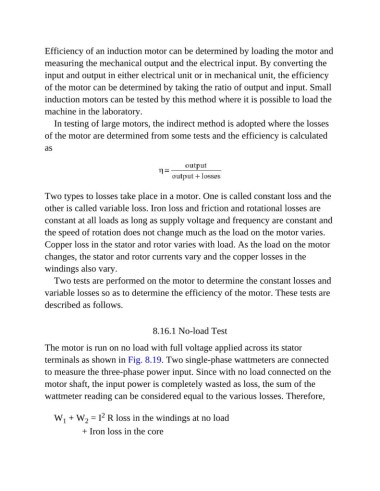
                  In testing of large motors, the indirect method is adopted where the losses

               of the motor are determined from some tests and the efficiency is calculated
               as


               Two types to losses take place in a motor. One is called constant loss and the
               other is called variable loss. Iron loss and friction and rotational losses are

               constant at all loads as long as supply voltage and frequency are constant and
               the speed of rotation does not change much as the load on the motor varies.

               Copper loss in the stator and rotor varies with load. As the load on the motor
               changes, the stator and rotor currents vary and the copper losses in the

               windings also vary.
                  Two tests are performed on the motor to determine the constant losses and
               variable losses so as to determine the efficiency of the motor. These tests are

               described as follows.


                                                  8.16.1 No-load Test

               The motor is run on no load with full voltage applied across its stator

               terminals as shown in Fig. 8.19. Two single-phase wattmeters are connected
               to measure the three-phase power input. Since with no load connected on the

               motor shaft, the input power is completely wasted as loss, the sum of the
               wattmeter reading can be considered equal to the various losses. Therefore,


                                  2
                  W  + W  = I  R loss in the windings at no load
                            2
                     1
                               + Iron loss in the core

