


Page 791 - Basic Electrical Engineering
P. 791
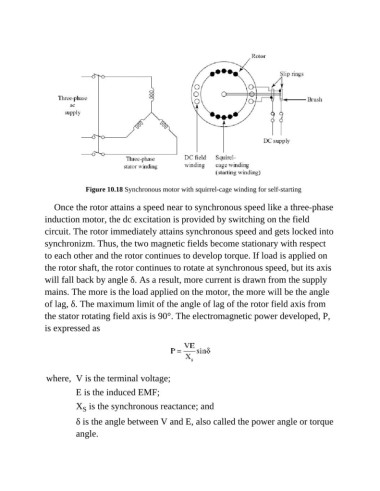
Figure 10.18 Synchronous motor with squirrel-cage winding for self-starting

                  Once the rotor attains a speed near to synchronous speed like a three-phase

               induction motor, the dc excitation is provided by switching on the field
               circuit. The rotor immediately attains synchronous speed and gets locked into
               synchronizm. Thus, the two magnetic fields become stationary with respect

               to each other and the rotor continues to develop torque. If load is applied on
               the rotor shaft, the rotor continues to rotate at synchronous speed, but its axis

               will fall back by angle δ. As a result, more current is drawn from the supply
               mains. The more is the load applied on the motor, the more will be the angle

               of lag, δ. The maximum limit of the angle of lag of the rotor field axis from
               the stator rotating field axis is 90°. The electromagnetic power developed, P,

               is expressed as


                where, V is the terminal voltage;
                         E is the induced EMF;

                         X  is the synchronous reactance; and
                            S
                         δ is the angle between V and E, also called the power angle or torque

                         angle.

