


Page 5 - AB INBEV 2018 Case Study 2
P. 5
P a g e  | 4


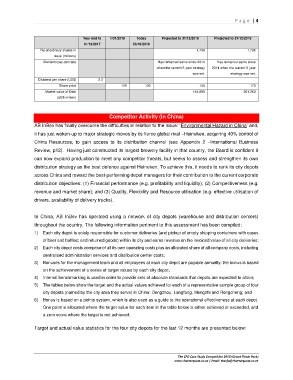
                                    Year end to   1/01/2018   Today   Projected to 31/12/2018   Projected to 31/12/2019
                                    31/12/2017           03/10/2018
                  No of ordinary shares in                                         1,736                1,736
                        issue (millions)
                   Dividend pay-out ratio                          Has remained same since 2014   Has remained same since
                                                                   when the current 5-year strategy   2014 when the current 5-year
                                                                                  was set.       strategy was set.
                 Dividend per share (US$)   2.2
                          Share price               115       132                   145                   170
                    Market value of Debt                                          145,890              301,260
                         (US$ million)


                                               Competitor Activity (in China)
               AB InBev has finally overcome the difficulties in relation to the issue: ‘Environmental Hazard in China’ and,
               it has just woken-up to major strategic moves by its fierce global rival –Heineken, acquiring 40% control of
               China  Resources,  to  gain  access  to  its  distribution  channel  (see  Appendix  2  –International  Business
               Review, p12).  Having just constructed its largest brewery facility in that country, the Board is confident it

               can now expand production to meet any competitor threats, but seeks to assess and strengthen its own
               distribution strategy as the best defence against Heineken. To achieve this, it needs to rank its city depots
               across China and reward the best-performing depot managers for their contribution to the current corporate
               distribution objectives: (1) Financial performance (e.g. profitability and liquidity); (2) Competitiveness (e.g.
               revenue and market share); and (3) Quality, Flexibility and Resource utilisation (e.g. effective utilisation of
               drivers, availability of delivery trucks).


               In  China,  AB  InBev  has  operated  using  a  network  of  city  depots  (warehouse  and  distribution  centers)
               throughout the country. The following information pertinent to this assessment has been compiled:
               1)  Each city depot is solely responsible for customer deliveries (and pickup of empty shipping containers with cases
                   of beer and bottles; and returned goods) within its city and earns revenue on the invoiced value of all city deliveries;
               2)  Each city depot costs comprise of all its own operating costs plus an allocated share of all company costs, including
                   centralised administration services and distribution center costs;
               3)  Bonuses for the management team and all employees at each city depot are payable annually: the bonus is based
                   on the achievement of a series of target values by each city depot;
               4)  Internal benchmarking is used in order to provide sets of absolute standards that depots are expected to attain;
               5)  The tables below show the target and the actual values achieved for each of a representative sample group of four
                   city depots (named by the city area they serve) in China: Dengzhou, Langfang, Mengzhi and Rongcheng; and
               6)  Bonus is based on a points system, which is also used as a guide to the operational effectiveness at each depot.
                   One point is allocated where the target value for each item in the table below is either achieved or exceeded, and
                   a zero score where the target is not achieved.

               Target and actual value statistics for the four city depots for the last 12 months are presented below:


                                                                           The CFO Case Study Competition 2018 (Grand Finale Pack)
                                                                          www.charterquest.co.za | Email: thecfo@charterquest.co.za

