


Page 139 - Computer Graphics Handout
P. 139
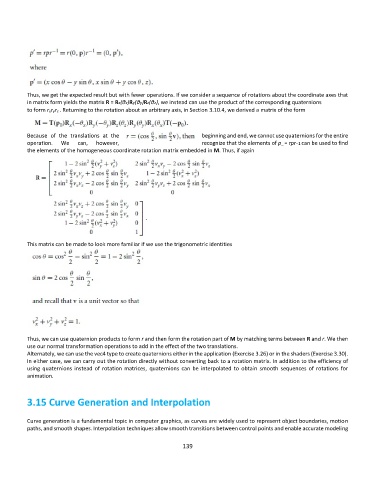
Thus, we get the expected result but with fewer operations. If we consider a sequence of rotations about the coordinate axes that
          in matrix form yields the matrix R = Rx(θx)Ry(θy)Rz(θz), we instead can use the product of the corresponding quaternions
          to form rxryrz . Returning to the rotation about an arbitrary axis, in Section 3.10.4, we derived a matrix of the form


          Because  of  the  translations  at  the                   beginning and end, we cannot use quaternions for the entire
          operation.   We   can,   however,                         recognize that the elements of p_ = rpr−1 can be used to find
          the elements of the homogeneous coordinate rotation matrix embedded in M. Thus, if again


          This matrix can be made to look more familiar if we use the trigonometric identities


          Thus, we can use quaternion products to form r and then form the rotation part of M by matching terms between R and r. We then
          use our normal transformation operations to add in the effect of the two translations.
          Alternately, we can use the vec4 type to create quaternions either in the application (Exercise 3.26) or in the shaders (Exercise 3.30).
          In either case, we can carry out the rotation directly without converting back to a rotation matrix. In addition to the efficiency of
          using  quaternions  instead  of  rotation  matrices,  quaternions  can  be  interpolated  to  obtain  smooth  sequences  of  rotations  for
          animation.


          3.15 Curve Generation and Interpolation


          Curve generation is a fundamental topic in computer graphics, as curves are widely used to represent object boundaries, motion
          paths, and smooth shapes. Interpolation techniques allow smooth transitions between control points and enable accurate modeling

                                                             139

