


Page 144 - Computer Graphics Handout
P. 144
When we introduced the synthetic-camera model in Chapter 1, we pointed out the similarities between classical and computer
          viewing. The basic elements in both cases are the same. We have objects, a viewer, projectors, and a projection plane (Figure 4.1).
          The projectors meet at the center of projection (COP). The COP corresponds to the center of the lens in the camera or in the eye,
          and in a computer-graphics system, it is the origin of the camera frame for perspective views. All standard graphics systems follow
          the model that we described in Chapter 1, which is based on geometric optics. The projection surface is a plane, and the projectors
          are straight lines. This situation is the one we usually encounter and is straightforward to implement, especially with our pipeline
          model. Both classical and computer graphics allow the viewer to be an infinite distance from the objects. Note that as we move the
          COP to infinity, the projectors become parallel and the COP can be replaced by a direction of projection (DOP), as shown in Figure
          4.2. Note also that as the COP moves to infinity, we can leave the projection plane fixed and the size of the image remains about
          the same, even though the COP is infinitely far from the objects. Views with a finite COP are called perspective views; views with a
          COP at infinity are called parallel views. For parallel views, the origin of the camera frame usually lies in the projection plane.
          Color Plates 9 and 10 show a parallel and a perspective rendering, resectively.
          These plates illustrate the importance of having both types of view available in applications such as architecture; in an API that
          supports both types of viewing, the user can switch easily between various viewing modes. Most modern APIs support both parallel
          and perspective viewing. The class of projections produced by these systems is known as planar geometric projections because the
          projection surface is a plane and the projectors are lines. Both perspective and parallel projections preserve lines; they do not, in
          general, preserve angles. Although the parallel views are the limiting case of perspective viewing, both classical and computer
          viewing usually treat them as separate cases. For classical views, the techniques that people use to construct the two types by hand
          are different, as anyone who has taken a drafting class surely knows. From the computer perspective, there are differences in how
          we specify the two types of views. Rather than looking at a parallel view as the limit of the perspective view, we derive the limiting
          equations and use those equations directly to form the corresponding projection matrix. In modern pipeline architectures, the
          projection matrix corresponding to either type of view can be loaded into the pipeline.
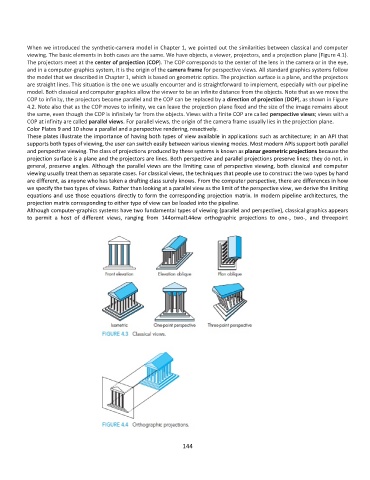
          Although computer-graphics systems have two fundamental types of viewing (parallel and perspective), classical graphics appears
          to  permit  a  host  of  different  views,  ranging  from  144ormal144ew  orthographic  projections  to  one-,  two-,  and  threepoint


                                                             144

