


Page 147 - Computer Graphics Handout
P. 147
viewing devices, including the human visual system, have a lens that is in a fixed relationship with the image plane—usually, the
          lens is parallel to the plane. Although these devices produce perspective views, if the viewer is far from the object, the views are
          approximately parallel, but orthogonal, because the projection plane is parallel to the lens. The bellows camera that we used to
          develop the synthetic-camera model in Section 1.6 has the flexibility to produce approximations to parallel oblique views.
          One use of such a camera is to create images of buildings in which the sides of the building are parallel rather than converging as
          they would be in an image created with an orthogonal view with the camera on the ground.
          From  the  application  programmer’s  point  of  view,  there  is  no  significant  difference  among  the  different  parallel  views.  The
          application programmer specifies a type of view—parallel or perspective—and a set of parameters that describe the camera.
          The problem for the application programmer is how to specify these parameters in the viewing procedures so as best to view an
          object or to produce a specific classical view.

          4.1.5 Perspective Viewing
          All perspective views are characterized by diminution of size. When objects are moved farther from the viewer, their images become
          smaller.  This  size  change  gives  perspective  views  their  natural  appearance;  however,  because  the  amount  by  which  a  line  is
          foreshortened depends on how far the line is from the viewer, we cannot make measurements from a perspective view. Hence, the
          major use of perspective views is n applications such as architecture and animation, where it is important to achieve natural-looking
          images.
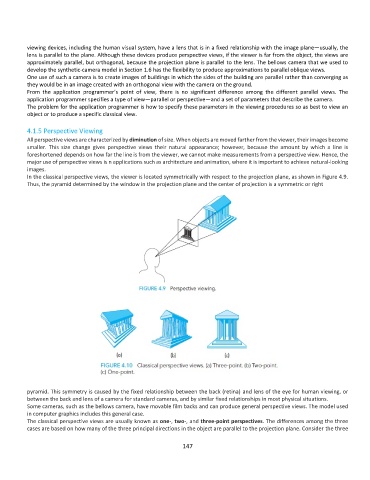
          In the classical perspective views, the viewer is located symmetrically with respect to the projection plane, as shown in Figure 4.9.
          Thus, the pyramid determined by the window in the projection plane and the center of projection is a symmetric or right


          pyramid. This symmetry is caused by the fixed relationship between the back (retina) and lens of the eye for human viewing, or
          between the back and lens of a camera for standard cameras, and by similar fixed relationships in most physical situations.
          Some cameras, such as the bellows camera, have movable film backs and can produce general perspective views. The model used
          in computer graphics includes this general case.
          The classical perspective views are usually known as one-, two-, and three-point perspectives. The differences among the three
          cases are based on how many of the three principal directions in the object are parallel to the projection plane. Consider the three

                                                             147

