


Page 150 - Computer Graphics Handout
P. 150
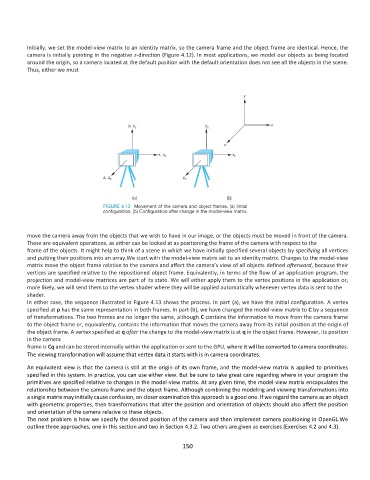
Initially, we set the model-view matrix to an identity matrix, so the camera frame and the object frame are identical. Hence, the
          camera is initially pointing in the negative z-direction (Figure 4.12). In most applications, we model our objects as being located
          around the origin, so a camera located at the default position with the default orientation does not see all the objects in the scene.
          Thus, either we must


          move the camera away from the objects that we wish to have in our image, or the objects must be moved in front of the camera.
          These are equivalent operations, as either can be looked at as positioning the frame of the camera with respect to the
          frame of the objects. It might help to think of a scene in which we have initially specified several objects by specifying all vertices
          and putting their positions into an array.We start with the model-view matrix set to an identity matrix. Changes to the model-view
          matrix move the object frame relative to the camera and affect the camera’s view of all objects defined afterward, because their
          vertices are specified relative to the repositioned object frame. Equivalently, in terms of the flow of an application program, the
          projection and model-view matrices are part of its state. We will either apply them to the vertex positions in the application or,
          more likely, we will send them to the vertex shader where they will be applied automatically whenever vertex data is sent to the
          shader.
          In either case, the sequence illustrated in Figure 4.13 shows the process. In part (a), we have the initial configuration. A vertex
          specified at p has the same representation in both frames. In part (b), we have changed the model-view matrix to C by a sequence
          of transformations. The two frames are no longer the same, although C contains the information to move from the camera frame
          to the object frame or, equivalently, contains the information that moves the camera away from its initial position at the origin of
          the object frame. A vertex specified at q after the change to the model-view matrix is at q in the object frame. However, its position
          in the camera
          frame is Cq and can be stored internally within the application or sent to the GPU, where it will be converted to camera coordinates.
          The viewing transformation will assume that vertex data it starts with is in camera coordinates.
          An equivalent view is that the camera is still at the origin of its own frame, and the model-view matrix is applied to primitives
          specified in this system. In practice, you can use either view. But be sure to take great care regarding where in your program the
          primitives are specified relative to changes in the model-view matrix. At any given time, the model-view matrix encapsulates the
          relationship between the camera frame and the object frame. Although combining the modeling and viewing transformations into
          a single matrix may initially cause confusion, on closer examination this approach is a good one. If we regard the camera as an object
          with geometric properties, then transformations that alter the position and orientation of objects should also affect the position
          and orientation of the camera relative to these objects.
          The next problem is how we specify the desired position of the camera and then implement camera positioning in OpenGL.We
          outline three approaches, one in this section and two in Section 4.3.2. Two others are given as exercises (Exercises 4.2 and 4.3).

                                                             150

