


Page 146 - Computer Graphics Handout
P. 146
object, only the faces parallel to the projection plane appear in the image. A viewer usually needs more than two views to visualize
          what an object looks like from its 146ormal146ew orthographic projections. Visualization from these images can require skill on the
          part of the viewer. The importance of this type of view is that it preserves both distances and angles, and because there is no
          distortion of either distance or shape, 146ormal146ew orthographic projections are well suited for working drawings.

          4.1.3 Axonometric Projections
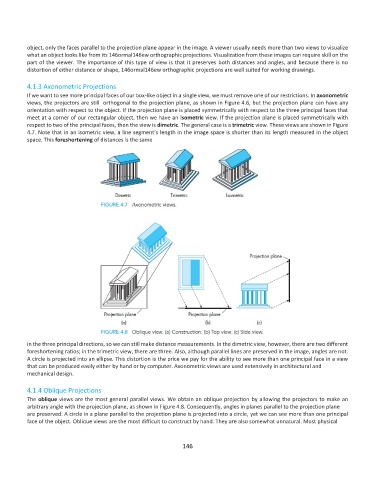
          If we want to see more principal faces of our box-like object in a single view, we must remove one of our restrictions. In axonometric
          views, the projectors are still  orthogonal to the projection plane, as shown in Figure 4.6, but the projection plane can have any
          orientation with respect to the object. If the projection plane is placed symmetrically with respect to the three principal faces that
          meet at a corner of our rectangular object, then we have an isometric view. If the projection plane is placed symmetrically with
          respect to two of the principal faces, then the view is dimetric. The general case is a trimetric view. These views are shown in Figure
          4.7. Note that in an isometric view, a line segment’s length in the image space is shorter than its length measured in the object
          space. This foreshortening of distances is the same


          in the three principal directions, so we can still make distance measurements. In the dimetric view, however, there are two different
          foreshortening ratios; in the trimetric view, there are three. Also, although parallel lines are preserved in the image, angles are not.
          A circle is projected into an ellipse. This distortion is the price we pay for the ability to see more than one principal face in a view
          that can be produced easily either by hand or by computer. Axonometric views are used extensively in architectural and
          mechanical design.

          4.1.4 Oblique Projections
          The oblique views are the most general parallel views. We obtain an oblique projection by allowing the projectors to make an
          arbitrary angle with the projection plane, as shown in Figure 4.8. Consequently, angles in planes parallel to the projection plane
          are preserved. A circle in a plane parallel to the projection plane is projected into a circle, yet we can see more than one principal
          face of the object. Oblique views are the most difficult to construct by hand. They are also somewhat unnatural. Most physical


                                                             146

