


Page 145 - Computer Graphics Handout
P. 145
perspectives. This seeming d screpancy arises in classical graphics as a result of the desire to show a specific relationship among an
          object, the viewer, and the projection plane, as opposed to the computer-graphics approach of complete independence of all
          specifications.

          4.1.1 Classical Viewing
          When an architect draws an image of a building, she knows which side she wishes to display and thus where she should place the
          viewer in relationship to the building. Each classical view is determined by a specific relationship between the objects and
          the  viewer.  In  classical  viewing,  there  is  the  underlying  notion  of  a  principal  face.  The  types  of  objects  viewed  in  real-world
          applications, such as architecture, tend to be composed of a number of planar faces, each of which can be thought of as a principal
          face. For a rectangular object, such as a building, there are natural notions of the front, back, top, bottom, right, and left faces. In
          addition, many real-world objects have faces that meet at right angles; thus, such objects often have three orthogonal directions
          associated with them. Figure 4.3 shows some of the main types of views. We start with the most restrictive view for each of the
          parallel and perspective types, and then move to the less restrictive conditions.

          4.1.2 Orthographic Projections
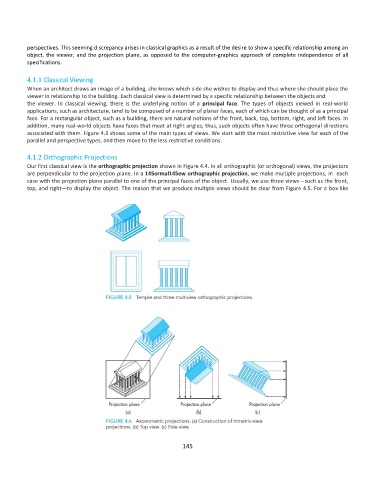
          Our first classical view is the orthographic projection shown in Figure 4.4. In all orthographic (or orthogonal) views, the projectors
          are perpendicular to the projection plane. In a 145ormal145ew orthographic projection, we make multiple projections, in  each
          case with the projection plane parallel to one of the principal faces of the object. Usually, we use three views—such as the front,
          top, and right—to display the object. The reason that we produce multiple views should be clear from Figure 4.5. For a box-like


                                                             145

