


Page 39 - DIVA1 2026
P. 39
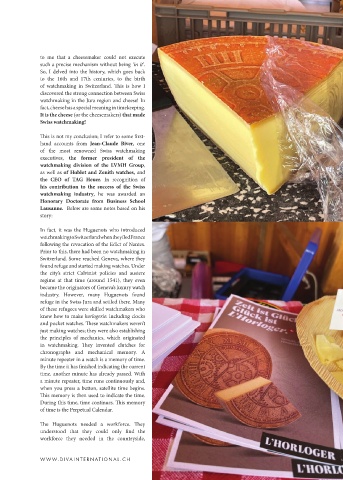
to  me  that  a  cheesemaker  could  not  execute
                   such a precise mechanism without being ‘in it’.
                   So,  I  delved  into  the  history,  which  goes  back
                   to  the  16th  and  17th  centuries,  to  the  birth
                   of  watchmaking  in  Switzerland.  This  is  how  I
                   discovered the strong connection between Swiss
                   watchmaking in the Jura region and cheese! In
                   fact, cheese has a special meaning in timekeeping.
                   It is the cheese (or the cheesemakers) that made
                   Swiss watchmaking!

                   This is not my conclusion; I refer to some first-
                   hand  accounts  from  Jean-Claude  Biver,  one
                   of  the  most  renowned  Swiss  watchmaking
                   executives,  the  former  president  of  the
                   watchmaking  division  of  the  LVMH  Group,
                   as well as of Hublot and Zenith watches, and
                   the  CEO  of  TAG  Heuer.  In  recognition  of
                   his  contribution  to  the  success  of  the  Swiss
                   watchmaking  industry,  he  was  awarded  an
                   Honorary  Doctorate  from  Business  School
                   Lausanne.  Below are some notes based on his
                   story:

                   In  fact,  it  was  the  Huguenots  who  introduced
                   watchmaking to Switzerland when they fled France
                   following the revocation of the Edict of Nantes.
                   Prior to this, there had been no watchmaking in
                   Switzerland. Some reached Geneva, where they
                   found refuge and started making watches. Under
                   the  city’s  strict  Calvinist  policies  and  austere
                   regime  at  that  time  (around  1541),  they  even
                   became the originators of Geneva’s luxury watch
                   industry.  However,  many  Huguenots  found
                   refuge in the Swiss Jura and settled there. Many
                   of these refugees were skilled watchmakers who
                   knew how to make horlogerie: including clocks
                   and pocket watches. These watchmakers weren’t
                   just making watches; they were also establishing
                   the  principles  of  mechanics,  which  originated
                   in  watchmaking.  They  invented  clutches  for
                   chronographs  and  mechanical  memory.  A
                   minute repeater in a watch is a memory of time.
                   By the time it has finished indicating the current
                   time, another minute has already passed. With
                   a minute repeater, time runs continuously and,
                   when you press a button, satellite time begins.
                   This memory is then used to indicate the time.
                   During this time, time continues. This memory
                   of time is the Perpetual Calendar.

                   The  Huguenots  needed  a  workforce.  They
                   understood  that  they  could  only  find  the
                   workforce  they  needed  in  the  countryside,


                   w w w. d i va i n t e r n at i o n a l . c h

