


Page 40 - DIVA1 2026
P. 40
culture


                                                                          when  people  are  poor,  they  cannot  afford  to
                                                                          waste anything, and they become meticulous.
                                                                          When  they  are  ‘imprisoned’  in  time  and  in
                                                                          closed  mountain  areas,  they  also  become
                                                                          patient. These meticulous and patient farmers
                                                                          were  also  creative  and  pragmatic,  as  well  as
                                                                          loyal  and  honest.  These  were  valuable  assets
                                                                          for developing the watchmaking industry, but
                                                                          not sufficient. As Biver describes it, ‘Once you
                                                                          are rigorous, precise, and patient, you have the
                                                                          qualities necessary to manage the fingers. It is
                                                                          the head that gives orders to the fingers. The best
                                                                          minds to move the best fingers would be found
                                                                          in the mountains, not on the plains. The farmers
                                                                          on the plains are not enclosed, so they lack the
                                                                          elements needed to make perfect clocks”.  So,
                                                                          the Huguenots approached the farmers living
                                                                          in the “accessible” but enclosed mountains of
                                                                          the Jura region, at altitudes ranging from 900
                                                                          to 1,500 meters. These farmers had never made
                                                                          watches  before,  but  the  Huguenots  told  them
                                                                          that  they  were  going  to  teach  them  how.  The
                                                                          Huguenots  were  sure  that  the  farmers  would
                                                                          polish small wheels patiently and meticulously,
                                                                          as  they  did  when  making  cheese.  And  what
                                                                          the Huguenots had hoped for happened. These
                                                                          farmers,  who  were  also  cheesemakers,  did
                                                                          everything to perfection. They were meticulous,
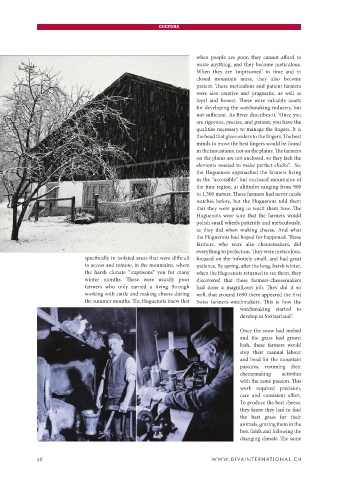
                                   specifically in isolated areas that were difficult   focused on the infinitely small, and had great
                                   to access and remote, in the mountains, where   patience. By spring, after the long, harsh winter,
                                   the  harsh  climate  “imprisons”  you  for  many   when the Huguenots returned to see them, they
                                   winter  months.  These  were  usually  poor   discovered  that  these  farmers-cheesemakers
                                   farmers  who  only  earned  a  living  through   had  done  a  magnificent  job.  They  did  it  so
                                   working with cattle and making cheese during   well, that around 1690 there appeared the first
                                   the summer months. The Huguenots knew that   Swiss  farmers-watchmakers.  This  is  how  the
                                                                                         watchmaking  started  to
                                                                                         develop in Switzerland”.

                                                                                         Once the snow had melted
                                                                                         and  the  grass  had  grown
                                                                                         lush,  these  farmers  would
                                                                                         stop  their  manual  labour
                                                                                         and head for the mountain
                                                                                         pastures,  resuming  their
                                                                                         cheesemaking   activities
                                                                                         with the same passion. This
                                                                                         work  required  precision,
                                                                                         care  and  consistent  effort.
                                                                                         To produce the best cheese,
                                                                                         they knew they had to find
                                                                                         the  best  grass  for  their
                                                                                         animals, grazing them in the
                                                                                         best fields and following the
                                                                                         changing climate. The same


                   0                                                           w w w. d i va i n t e r n at i o n a l . c h

