


Page 207 - Demo
P. 207
JOHN
39Many of the Samaritans of that town began to believe in him because of the word of the woman* who testi ed, “He told me everything I have done.” 40When the Samaritans came to him, they invited him to stay with them; and he stayed there two days. 41Many more began to believe in him because of his word, 42and they said to the woman, “We no longer believe because of your word; for we have heard for ourselves, and we know that this is truly the savior of the world.”q
Return to Galilee. 43* After the two days, he left there for Galilee. 44* r For Jesus himself testi ed that a prophet has no honor in his native place. 45When he came into Galilee, the Galileans welcomed him, since they had seen all he had done in Jerusalem at the feast; for they themselves had gone to the feast.
Second Sign at Cana.* 46s Then he returned to Cana in Galilee, where he had made the water wine. Now there was a royal o cial whose son was ill in Capernaum. 47When he heard that
Jesus had arrived in Galilee from Judea, he went
to him and asked him to come down and heal his son, who was near death. 48Jesus said to him, “Unless you people see signs and wonders, you will not believe.”t 49The royal o cial said to him, “Sir, come down before my child dies.” 50Jesus said to him, “You may go; your son will live.” The man believed what Jesus said to him and left.u 51While he was on his way back, his slaves met him and told him that his boy would live. 52He asked them when he began to recover. They told him, “The fever left him yesterday, about one in the afternoon.” 53The father realized that just at that time Jesus had said to him, “Your son will live,” and he and his whole household came to believe. 54[Now] this was the second sign Jesus did when he came to Galilee from Judea.v
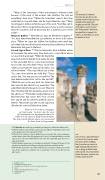
Ruins of a 4th-century synagogue at Capernaum. In Jesus’ day, the town of Capernaum was an important base for soldiers in the army of King Herod Antipas. The non-Jewish of cial whose son was healed by Jesus lived in Capernaum.
4:39
The woman of Samaria becomes an apostle as she spreads the word about Jesus and about his profound insight into her life. The task of disciples is not to hoard the “living water” they have received but to impart it to others, so that they, too, may be drawn to Jesus.
4:46
Two of Jesus’ signs take place in Cana. First, he turns water into wine at the wedding feast; now he encounters a high-ranking o cial whose son is dying, and heals him with a word. Jesus transforms water into wine, sickness into health, death into life.
195
* [4:36] Already: this word may go with the preceding verse rather than with Jn 4:36.
* [4:39] The woman is presented as a missionary, described in virtually the same words
as the disciples are in Jesus’ prayer (Jn 17:20).
* [4:43–54] Jesus’ arrival in Cana in Galilee; the second sign. This section introduces
another theme, that of the life-giving word of Jesus. It is explicitly linked to the rst sign (Jn 2:11). The royal o cial believes (Jn 4:50). The natural life given his son is a sign of eternal life.
* [4:44] Probably a reminiscence of a tradition as in Mk 6:4. Cf. Gospel of Thomas 31: “No prophet is acceptable in his village, no physician heals those who know him.”
* [4:46–54] The story of the cure of the royal o cial’s son may be a third version of the cure of the centurion’s son (Mt 8:5–13) or servant (Lk 7:1–10). Cf. also Mt 15:21–28; Mk 7:24–30.
q. [4:42] 1 Jn 4:14.
r. [4:44] Mt 13:57; Mk 6:4; Lk 4:24.
s. [4:46–54] 2:1–11; Mt 8:5–13; 15:21–28; Mk 7:24–30; Lk 7:1–10.
t. [4:48] 2:18, 23; Wis 8:8; Mt 12:38; 1 Cor 1:22.
u. [4:50] 1 Kgs 17:23.
v. [4:54] 2:11.


