


Page 127 - Handout of Computer Architecture (1)..
P. 127
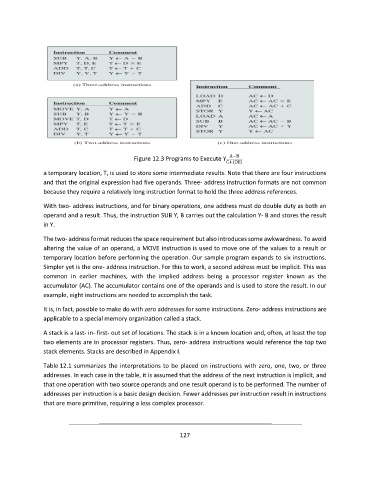
Figure 12.3 Programs to Execute Y  A−B
                                                                            C+(DE)
               a temporary location, T, is used to store some intermediate results. Note that there are four instructions
               and that the original expression had five operands. Three- address instruction formats are not common
               because they require a relatively long instruction format to hold the three address references.

               With two- address instructions, and for binary operations, one address must do double duty as both an
               operand and a result. Thus, the instruction SUB Y, B carries out the calculation Y- B and stores the result
               in Y.

               The two- address format reduces the space requirement but also introduces some awkwardness. To avoid
               altering the value of an operand, a MOVE instruction is used to move one of the values to a result or
               temporary location before performing the operation. Our sample program expands to six instructions.
               Simpler yet is the one- address instruction. For this to work, a second address must be implicit. This was
               common  in  earlier  machines,  with  the  implied  address  being  a  processor  register  known  as  the
               accumulator (AC). The accumulator contains one of the operands and is used to store the result. In our
               example, eight instructions are needed to accomplish the task.

               It is, in fact, possible to make do with zero addresses for some instructions. Zero- address instructions are
               applicable to a special memory organization called a stack.

               A stack is a last- in- first- out set of locations. The stack is in a known location and, often, at least the top
               two elements are in processor registers. Thus, zero- address instructions would reference the top two
               stack elements. Stacks are described in Appendix I.

               Table 12.1 summarizes the interpretations to be placed on instructions with zero, one, two, or three
               addresses. In each case in the table, it is assumed that the address of the next instruction is implicit, and
               that one operation with two source operands and one result operand is to be performed. The number of
               addresses per instruction is a basic design decision. Fewer addresses per instruction result in instructions
               that are more primitive, requiring a less complex processor.


                                                             127

