


Page 128 - Handout of Computer Architecture (1)..
P. 128
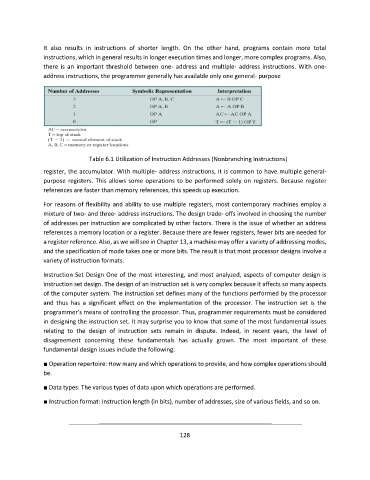
It  also  results  in  instructions  of  shorter  length.  On  the  other  hand,  programs  contain  more  total
               instructions, which in general results in longer execution times and longer, more complex programs. Also,
               there  is  an  important  threshold  between one-  address  and  multiple-  address  instructions.  With one-
               address instructions, the programmer generally has available only one general- purpose


                               Table 6.1 Utilization of Instruction Addresses (Nonbranching Instructions)

               register, the accumulator. With multiple- address instructions, it is common to have multiple general-
               purpose registers. This allows some operations to be performed solely on registers. Because register
               references are faster than memory references, this speeds up execution.


               For reasons of flexibility and ability to use multiple registers, most contemporary machines employ a
               mixture of two- and three- address instructions. The design trade- offs involved in choosing the number
               of addresses per instruction are complicated by other factors. There is the issue of whether an address
               references a memory location or a register. Because there are fewer registers, fewer bits are needed for
               a register reference. Also, as we will see in Chapter 13, a machine may offer a variety of addressing modes,
               and the specification of mode takes one or more bits. The result is that most processor designs involve a
               variety of instruction formats.

               Instruction Set Design One of the most interesting, and most analyzed, aspects of computer design is
               instruction set design. The design of an instruction set is very complex because it affects so many aspects
               of the computer system. The instruction set defines many of the functions performed by the processor
               and  thus  has  a  significant  effect  on  the  implementation  of  the  processor.  The  instruction  set  is  the
               programmer’s means of controlling the processor. Thus, programmer requirements must be considered
               in designing the instruction set. It may surprise you to know that some of the most fundamental issues
               relating  to  the  design  of  instruction  sets  remain  in  dispute.  Indeed,  in  recent  years,  the  level  of
               disagreement  concerning  these  fundamentals  has  actually  grown.  The  most  important  of  these
               fundamental design issues include the following:
               ■ Operation repertoire: How many and which operations to provide, and how complex operations should
               be.

               ■ Data types: The various types of data upon which operations are performed.

               ■ Instruction format: Instruction length (in bits), number of addresses, size of various fields, and so on.


                                                             128

