


Page 123 - Handout of Computer Architecture (1)..
P. 123
MACHINE INSTRUCTION CHARACTERISTICS
               The operation of the processor is determined by the instructions it executes, referred to as machine
               instructions  or  computer  instructions.  The  collection  of  different  instructions  that  the  processor  can
               execute is referred to as the processor’s instruction set

               Elements  of  a  Machine  Instruction  Each  instruction  must  contain  the  information  required  by  the
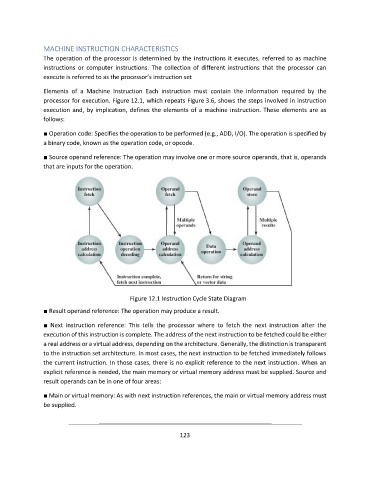
               processor for execution. Figure 12.1, which repeats Figure 3.6, shows the steps involved in instruction
               execution and, by implication, defines the elements of a machine instruction. These elements are as
               follows:

               ■ Operation code: Specifies the operation to be performed (e.g., ADD, I/O). The operation is specified by
               a binary code, known as the operation code, or opcode.

               ■ Source operand reference: The operation may involve one or more source operands, that is, operands
               that are inputs for the operation.


                                            Figure 12.1 Instruction Cycle State Diagram

               ■ Result operand reference: The operation may produce a result.
               ■  Next  instruction  reference:  This  tells  the  processor  where  to  fetch  the  next  instruction  after  the
               execution of this instruction is complete. The address of the next instruction to be fetched could be either
               a real address or a virtual address, depending on the architecture. Generally, the distinction is transparent
               to the instruction set architecture. In most cases, the next instruction to be fetched immediately follows
               the current instruction. In those cases, there is no explicit reference to the next instruction. When an
               explicit reference is needed, the main memory or virtual memory address must be supplied. Source and
               result operands can be in one of four areas:

               ■ Main or virtual memory: As with next instruction references, the main or virtual memory address must
               be supplied.


                                                             123

