


Page 124 - Handout of Computer Architecture (1)..
P. 124
■  Processor  register:  With  rare  exceptions,  a  processor  contains  one  or  more  registers  that  may  be
               referenced by machine instructions. If only one register exists, reference to it may be implicit. If more than
               one register exists, then each register is assigned a unique name or number, and the instruction must
               contain the number of the desired register.

               ■ Immediate: The value of the operand is contained in a field in the instruction being executed.

               ■  I/O  device:  The  instruction  must  specify  the  I/O module  and  device  for the operation.  If memory-
               mapped I/O is used, this is just another main or virtual memory address.

               Instruction Representation

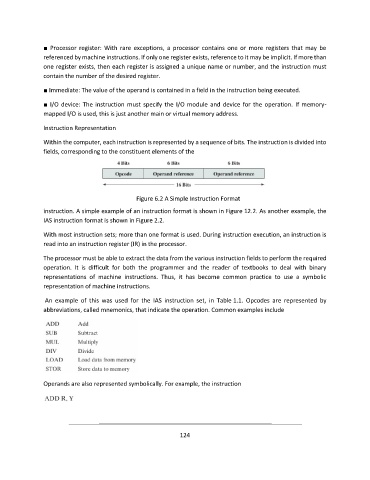
               Within the computer, each instruction is represented by a sequence of bits. The instruction is divided into
               fields, corresponding to the constituent elements of the


                                              Figure 6.2 A Simple Instruction Format

               instruction. A simple example of an instruction format is shown in Figure 12.2. As another example, the
               IAS instruction format is shown in Figure 2.2.

               With most instruction sets; more than one format is used. During instruction execution, an instruction is
               read into an instruction register (IR) in the processor.

               The processor must be able to extract the data from the various instruction fields to perform the required
               operation.  It  is  difficult  for  both  the  programmer  and  the  reader  of  textbooks  to  deal  with  binary
               representations  of  machine  instructions.  Thus,  it  has  become  common  practice  to  use  a  symbolic
               representation of machine instructions.

                An  example  of  this  was  used  for  the  IAS  instruction  set,  in  Table 1.1.  Opcodes  are  represented  by
               abbreviations, called mnemonics, that indicate the operation. Common examples include


               Operands are also represented symbolically. For example, the instruction


                                                             124

