


Page 171 - Handout of Computer Architecture (1)..
P. 171
complicated than, and execute about as fast as, microinstructions on CISC machines (discussed in Part
               Four).  With  simple,  one-  cycle  instructions,  there  is  little  or  no  need  for  microcode;  the  machine
               instructions  can  be  hardwired.  Such  instructions  should  execute  faster  than  comparable  machine
               instructions on other machines, because it is not necessary to access a microprogram control store during
               instruction execution.

               A second characteristic is that most operations should be register to register, with only simple LOAD and
               STORE operations accessing memory. This design feature simplifies the instruction set and therefore the
               control unit. For example, a RISC instruction set may include only one or two ADD instructions (e.g.,
               integer add, add with carry); the VAX has 25 different ADD instructions. Another benefit is that such an
               architecture encourages the optimization of register use, so that frequently accessed operands remain in
               high-  speed  storage.  This  emphasis  on  register-  to-  register  operations  is  notable  for  RISC  designs.
               Contemporary CISC machines provide such instructions but also include memory- to- memory and mixed
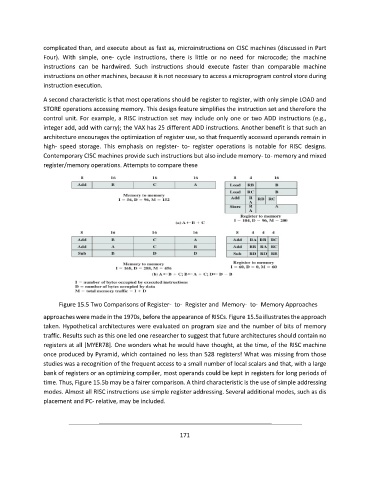
               register/memory operations. Attempts to compare these


                     Figure 15.5 Two Comparisons of Register-  to-  Register and  Memory-  to-  Memory Approaches

               approaches were made in the 1970s, before the appearance of RISCs. Figure 15.5a illustrates the approach
               taken. Hypothetical architectures were evaluated on program size and the number of bits of memory
               traffic. Results such as this one led one researcher to suggest that future architectures should contain no
               registers at all [MYER78]. One wonders what he would have thought, at the time, of the RISC machine
               once produced by Pyramid, which contained no less than 528 registers! What was missing from those
               studies was a recognition of the frequent access to a small number of local scalars and that, with a large
               bank of registers or an optimizing compiler, most operands could be kept in registers for long periods of
               time. Thus, Figure 15.5b may be a fairer comparison. A third characteristic is the use of simple addressing
               modes. Almost all RISC instructions use simple register addressing. Several additional modes, such as dis
               placement and PC- relative, may be included.


                                                             171

