


Page 170 - Handout of Computer Architecture (1)..
P. 170
rather than as a series of more primitive instructions. However, because of the bias toward the use of
               those simpler instructions, this may not be so.

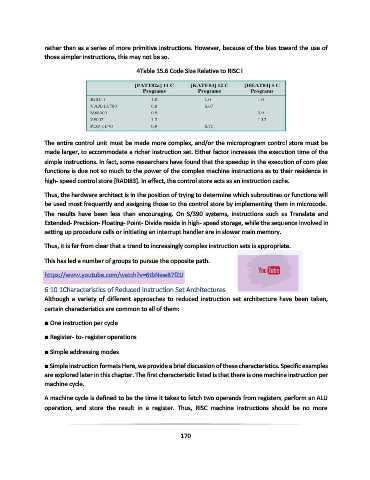
                                              4Table 15.6 Code Size Relative to RISC I


               The entire control unit must be made more complex, and/or the microprogram control store must be
               made larger, to accommodate a richer instruction set. Either factor increases the execution time of the
               simple instructions. In fact, some researchers have found that the speedup in the execution of com plex
               functions is due not so much to the power of the complex machine instructions as to their residence in
               high- speed control store [RADI83]. In effect, the control store acts as an instruction cache.

               Thus, the hardware architect is in the position of trying to determine which subroutines or functions will
               be used most frequently and assigning those to the control store by implementing them in microcode.
               The  results  have  been  less  than  encouraging.  On  S/390  systems,  instructions  such  as  Translate  and
               Extended- Precision- Floating- Point- Divide reside in high- speed storage, while the sequence involved in
               setting up procedure calls or initiating an interrupt handler are in slower main memory.

               Thus, it is far from clear that a trend to increasingly complex instruction sets is appropriate.

               This has led a number of groups to pursue the opposite path.

               https://www.youtube.com/watch?v=6tbNew87fZU

               6.10.1Characteristics of Reduced Instruction Set Architectures
               Although  a  variety  of  different  approaches  to  reduced  instruction  set  architecture  have  been  taken,
               certain characteristics are common to all of them:

               ■ One instruction per cycle

               ■ Register- to- register operations

               ■ Simple addressing modes

               ■ Simple instruction formats Here, we provide a brief discussion of these characteristics. Specific examples
               are explored later in this chapter. The first characteristic listed is that there is one machine instruction per
               machine cycle.

               A machine cycle is defined to be the time it takes to fetch two operands from registers, perform an ALU
               operation,  and  store  the  result  in  a  register.  Thus,  RISC  machine  instructions  should  be  no  more


                                                             170

