


Page 175 - Handout of Computer Architecture (1)..
P. 175
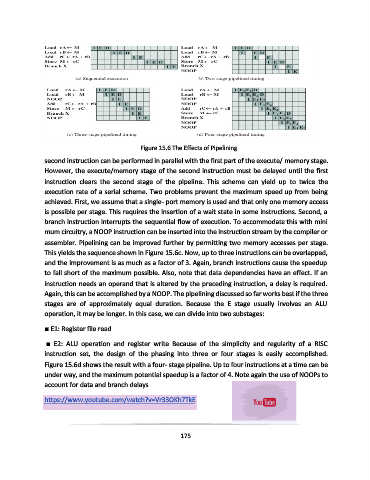
Figure 15.6 The Effects of Pipelining
               second instruction can be performed in parallel with the first part of the execute/ memory stage.

               However, the execute/memory stage of the second instruction must be delayed until the first
               instruction  clears  the  second  stage  of  the  pipeline.  This  scheme  can  yield  up  to  twice  the
               execution rate of a serial scheme. Two problems prevent the maximum speed up from being
               achieved. First, we assume that a single- port memory is used and that only one memory access
               is possible per stage. This requires the insertion of a wait state in some instructions. Second, a
               branch instruction interrupts the sequential flow of execution. To accommodate this with mini
               mum circuitry, a NOOP instruction can be inserted into the instruction stream by the compiler or
               assembler. Pipelining can be improved further by permitting two memory accesses per stage.

               This yields the sequence shown in Figure 15.6c. Now, up to three instructions can be overlapped,
               and the improvement is as much as a factor of 3. Again, branch instructions cause the speedup
               to fall short of the maximum possible. Also, note that data dependencies have an effect. If an
               instruction needs an operand that is altered by the preceding instruction, a delay is required.
               Again, this can be accomplished by a NOOP. The pipelining discussed so far works best if the three
               stages  are  of  approximately  equal  duration.  Because  the  E  stage  usually  involves  an  ALU
               operation, it may be longer. In this case, we can divide into two substages:

               ■ E1: Register file read

                ■  E2:  ALU  operation  and  register  write  Because  of  the  simplicity  and  regularity  of  a  RISC
               instruction  set,  the  design  of  the  phasing  into  three  or  four  stages  is  easily  accomplished.
               Figure 15.6d shows the result with a four- stage pipeline. Up to four instructions at a time can be

               under way, and the maximum potential speedup is a factor of 4. Note again the use of NOOPs to
               account for data and branch delays

               https://www.youtube.com/watch?v=Vr33OKh7TkE


                                                             175

