


Page 177 - Handout of Computer Architecture (1)..
P. 177
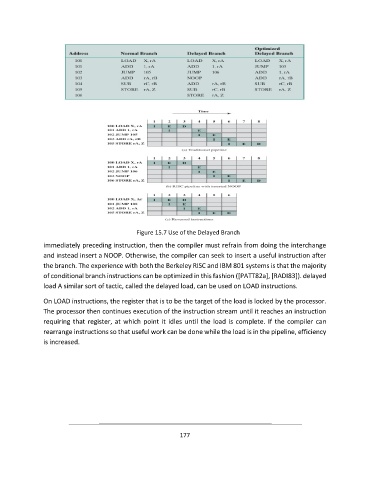
Figure 15.7 Use of the Delayed Branch

               immediately preceding instruction, then the compiler must refrain from doing the interchange
               and instead insert a NOOP. Otherwise, the compiler can seek to insert a useful instruction after
               the branch. The experience with both the Berkeley RISC and IBM 801 systems is that the majority
               of conditional branch instructions can be optimized in this fashion ([PATT82a], [RADI83]). delayed
               load A similar sort of tactic, called the delayed load, can be used on LOAD instructions.


               On LOAD instructions, the register that is to be the target of the load is locked by the processor.
               The processor then continues execution of the instruction stream until it reaches an instruction
               requiring that register, at which point it idles until the load is complete. If the compiler can
               rearrange instructions so that useful work can be done while the load is in the pipeline, efficiency
               is increased.


                                                             177

