


Page 173 - Handout of Computer Architecture (1)..
P. 173
no longer “pure” RISC and the more recent CISC designs, notably the Pentium II and later Pentium models,
               do incorporate some RISC characteristics. An interesting comparison in [MASH95] provides some insight
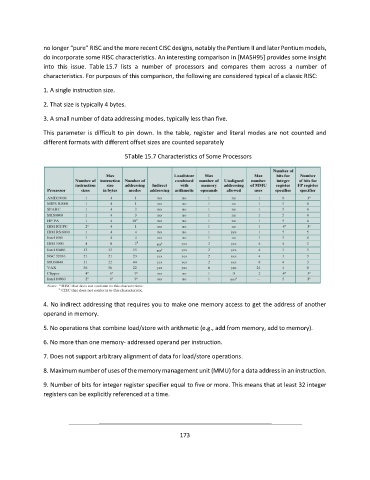
               into  this  issue.  Table 15.7  lists  a  number  of  processors  and  compares  them  across  a  number  of
               characteristics. For purposes of this comparison, the following are considered typical of a classic RISC:

               1. A single instruction size.

               2. That size is typically 4 bytes.

               3. A small number of data addressing modes, typically less than five.

               This  parameter  is  difficult  to  pin  down.  In  the  table,  register  and  literal  modes  are  not  counted  and
               different formats with different offset sizes are counted separately

                                          5Table 15.7 Characteristics of Some Processors


               4. No indirect addressing that requires you to make one memory access to get the address of another
               operand in memory.

               5. No operations that combine load/store with arithmetic (e.g., add from memory, add to memory).

               6. No more than one memory- addressed operand per instruction.

               7. Does not support arbitrary alignment of data for load/store operations.

               8. Maximum number of uses of the memory management unit (MMU) for a data address in an instruction.

               9. Number of bits for integer register specifier equal to five or more. This means that at least 32 integer
               registers can be explicitly referenced at a time.


                                                             173

