


Page 178 - Handout of Computer Architecture (1)..
P. 178
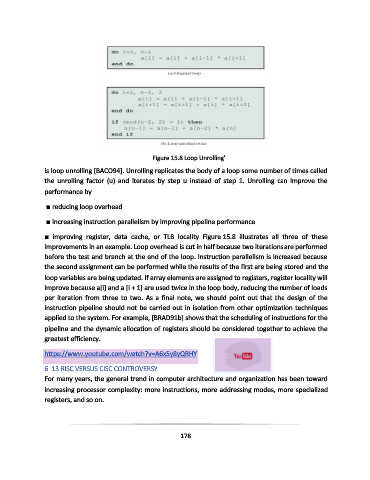
Figure 15.8 Loop Unrolling’

               is loop unrolling [BACO94]. Unrolling replicates the body of a loop some number of times called
               the  unrolling  factor  (u)  and  iterates  by  step  u  instead  of  step  1.  Unrolling  can  improve  the
               performance by

                ■ reducing loop overhead

                ■ increasing instruction parallelism by improving pipeline performance

               ■  improving  register,  data  cache,  or  TLB  locality  Figure 15.8  illustrates  all  three  of  these
               improvements in an example. Loop overhead is cut in half because two iterations are performed
               before the test and branch at the end of the loop. Instruction parallelism is increased because
               the second assignment can be performed while the results of the first are being stored and the
               loop variables are being updated. If array elements are assigned to registers, register locality will

               improve because a[i] and a [i + 1] are used twice in the loop body, reducing the number of loads
               per iteration from three to two. As a final note, we should point out that the design of the
               instruction pipeline should not be carried out in isolation from other optimization techniques
               applied to the system. For example, [BRAD91b] shows that the scheduling of instructions for the
               pipeline and the dynamic allocation of registers should be considered together to achieve the
               greatest efficiency.

               https://www.youtube.com/watch?v=A6x5y8yQRHY

               6. 13 RISC VERSUS CISC CONTROVERSY

               For many years, the general trend in computer architecture and organization has been toward
               increasing processor complexity: more instructions, more addressing modes, more specialized
               registers, and so on.


                                                             178

