


Page 165 - Handout of Computer Architecture (1)..
P. 165
■ Supervisor: Indicates whether the processor is executing in supervisor or user mode. Certain privileged
               instructions can be executed only in supervisor mode, and certain areas of memory can be accessed only
               in supervisor mode.

               A number of other registers related to status and control might be found in a particular processor design.
               There may be a pointer to a block of memory containing additional status information (e.g., process
               control blocks). In machines using vectored interrupts, an interrupt vector register may be provided. If a
               stack is used to implement certain functions (e.g., subroutine call), then a system stack pointer is needed.

               A page table pointer is used with a virtual memory system. Finally, registers may be used in the control of
               I/O operations. A number of factors go into the design of the control and status register organization.

               One key issue is operating system support. Certain types of control information are of specific utility to
               the operating system. If the processor designer has a functional understanding of the operating system
               to be used, then the register organization can to some extent be tailored to the operating system. Another
               key design decision is the allocation of control information between registers and memory. It is common
               to dedicate the first (lowest) few hundred or


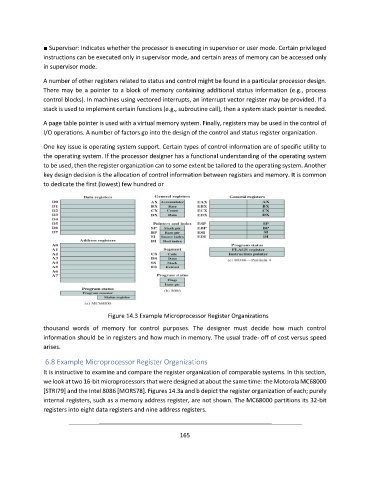
                                     Figure 14.3 Example Microprocessor Register Organizations

               thousand  words  of  memory  for  control  purposes.  The  designer  must  decide  how  much  control
               information should be in registers and how much in memory. The usual trade- off of cost versus speed
               arises.

                6.8 Example Microprocessor Register Organizations
               It is instructive to examine and compare the register organization of comparable systems. In this section,
               we look at two 16-bit microprocessors that were designed at about the same time: the Motorola MC68000
               [STRI79] and the Intel 8086 [MORS78]. Figures 14.3a and b depict the register organization of each; purely
               internal registers, such as a memory address register, are not shown. The MC68000 partitions its 32-bit
               registers into eight data registers and nine address registers.


                                                             165

