


Page 161 - Handout of Computer Architecture (1)..
P. 161
The reader will recall that the major components of the processor are an arithmetic and logic unit (ALU)
               and a control unit (CU).

               The ALU does the actual computation or processing of data. The control unit controls the movement of
               data and instructions into and out of the processor and controls the operation of the ALU. In addition, the
               figure  shows  a  minimal  internal  memory,  consisting  of  a  set  of  storage  locations,  called  registers.
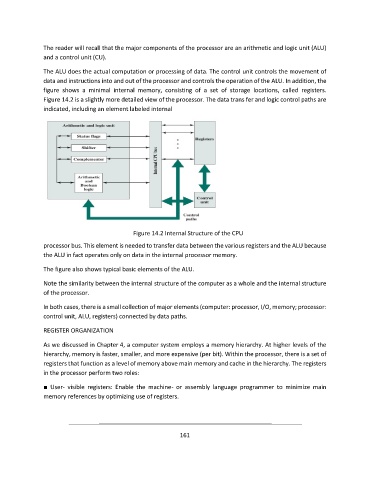
               Figure 14.2 is a slightly more detailed view of the processor. The data trans fer and logic control paths are
               indicated, including an element labeled internal


                                             Figure 14.2 Internal Structure of the CPU
               processor bus. This element is needed to transfer data between the various registers and the ALU because
               the ALU in fact operates only on data in the internal processor memory.

               The figure also shows typical basic elements of the ALU.

               Note the similarity between the internal structure of the computer as a whole and the internal structure
               of the processor.

               In both cases, there is a small collection of major elements (computer: processor, I/O, memory; processor:
               control unit, ALU, registers) connected by data paths.

               REGISTER ORGANIZATION
               As we discussed in Chapter 4, a computer system employs a memory hierarchy. At higher levels of the
               hierarchy, memory is faster, smaller, and more expensive (per bit). Within the processor, there is a set of
               registers that function as a level of memory above main memory and cache in the hierarchy. The registers
               in the processor perform two roles:

               ■  User-  visible  registers:  Enable  the  machine-  or  assembly  language  programmer  to  minimize  main
               memory references by optimizing use of registers.


                                                             161

