


Page 158 - Handout of Computer Architecture (1)..
P. 158
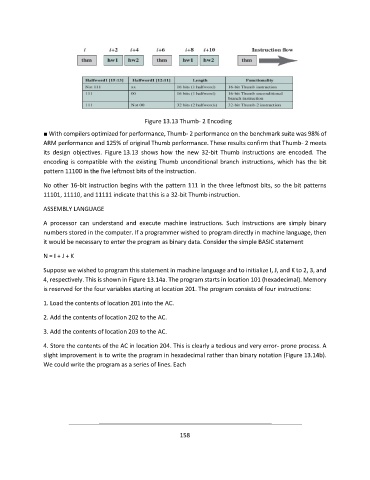
Figure 13.13 Thumb- 2 Encoding

               ■ With compilers optimized for performance, Thumb- 2 performance on the benchmark suite was 98% of
               ARM performance and 125% of original Thumb performance. These results confirm that Thumb- 2 meets
               its  design  objectives.  Figure 13.13  shows  how  the  new  32-bit  Thumb  instructions  are  encoded.  The
               encoding is compatible with the existing Thumb unconditional branch instructions, which has the bit
               pattern 11100 in the five leftmost bits of the instruction.

               No other 16-bit instruction begins with the pattern 111 in the three leftmost bits, so the bit patterns
               11101, 11110, and 11111 indicate that this is a 32-bit Thumb instruction.
               ASSEMBLY LANGUAGE

               A  processor  can  understand  and  execute  machine  instructions.  Such  instructions  are  simply  binary
               numbers stored in the computer. If a programmer wished to program directly in machine language, then
               it would be necessary to enter the program as binary data. Consider the simple BASIC statement

               N = I + J + K

               Suppose we wished to program this statement in machine language and to initialize I, J, and K to 2, 3, and
               4, respectively. This is shown in Figure 13.14a. The program starts in location 101 (hexadecimal). Memory
               is reserved for the four variables starting at location 201. The program consists of four instructions:

               1. Load the contents of location 201 into the AC.

               2. Add the contents of location 202 to the AC.

               3. Add the contents of location 203 to the AC.

               4. Store the contents of the AC in location 204. This is clearly a tedious and very error- prone process. A
               slight improvement is to write the program in hexadecimal rather than binary notation (Figure 13.14b).
               We could write the program as a series of lines. Each


                                                             158

