


Page 153 - Handout of Computer Architecture (1)..
P. 153
increased complexity of the processor compared with a processor with a simpler instruction set and
               format. We return to these matters in Chapter 15, where we examine the case for very simple instruction
               sets.

               https://www.youtube.com/watch?v=wudyP4kkKLY

               x86 AND ARM INSTRUCTION FORMATS

               x86  Instruction  Formats  The  x86  is  equipped  with  a  variety  of  instruction  formats.  Of  the  elements
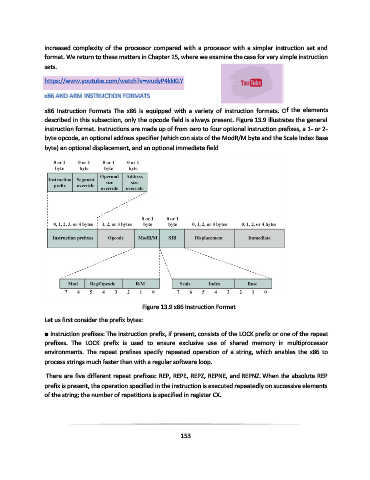
               described in this subsection, only the opcode field is always present. Figure 13.9 illustrates the general
               instruction format. Instructions are made up of from zero to four optional instruction prefixes, a 1- or 2-
               byte opcode, an optional address specifier (which con sists of the ModR/M byte and the Scale Index Base
               byte) an optional displacement, and an optional immediate field


                                                Figure 13.9 x86 Instruction Format
               Let us first consider the prefix bytes:

               ■ Instruction prefixes: The instruction prefix, if present, consists of the LOCK prefix or one of the repeat
               prefixes.  The  LOCK  prefix  is  used  to  ensure  exclusive  use  of  shared  memory  in  multiprocessor
               environments.  The  repeat  prefixes  specify  repeated  operation  of  a  string,  which  enables  the  x86  to
               process strings much faster than with a regular software loop.

                There are five different repeat prefixes: REP, REPE, REPZ, REPNE, and REPNZ. When the absolute REP
               prefix is present, the operation specified in the instruction is executed repeatedly on successive elements
               of the string; the number of repetitions is specified in register CX.


                                                             153

