


Page 148 - Handout of Computer Architecture (1)..
P. 148
Address calculation is based on references to page 0 or the current page (page containing this instruction)
               as determined by the page bit. The second modifier bit indicates whether direct or indirect addressing is
               to be used. These two modes can be used in combination, so that an indirect address is a 12-bit address
               contained in a word of page 0 or the current page. In addition, 8 dedicated words on page 0 are auto index
               “registers.” When an indirect reference is made to one of these locations, reindexing occurs. Figure 13.5
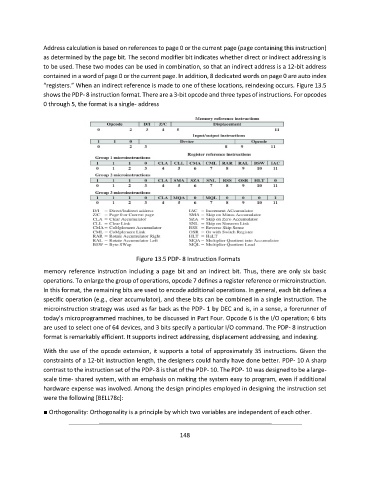
               shows the PDP- 8 instruction format. There are a 3-bit opcode and three types of instructions. For opcodes
               0 through 5, the format is a single- address


                                              Figure 13.5 PDP- 8 Instruction Formats
               memory  reference  instruction  including  a  page  bit and  an  indirect  bit.  Thus, there are only  six  basic
               operations. To enlarge the group of operations, opcode 7 defines a register reference or microinstruction.
               In this format, the remaining bits are used to encode additional operations. In general, each bit defines a
               specific operation (e.g., clear accumulator), and these bits can be combined in a single instruction. The
               microinstruction strategy was used as far back as the PDP- 1 by DEC and is, in a sense, a forerunner of
               today’s microprogrammed machines, to be discussed in Part Four. Opcode 6 is the I/O operation; 6 bits
               are used to select one of 64 devices, and 3 bits specify a particular I/O command. The PDP- 8 instruction
               format is remarkably efficient. It supports indirect addressing, displacement addressing, and indexing.

               With the use of the opcode extension, it supports a total of approximately 35 instructions. Given the
               constraints of a 12-bit instruction length, the designers could hardly have done better. PDP- 10 A sharp
               contrast to the instruction set of the PDP- 8 is that of the PDP- 10. The PDP- 10 was designed to be a large-
               scale time- shared system, with an emphasis on making the system easy to program, even if additional
               hardware expense was involved. Among the design principles employed in designing the instruction set
               were the following [BELL78c]:
               ■ Orthogonality: Orthogonality is a principle by which two variables are independent of each other.


                                                             148

