


Page 143 - Handout of Computer Architecture (1)..
P. 143
a dis placement to be added to a register, in this case called an index register. The index register may be
               any  of  the  general-  purpose  registers  except  the  one  called  ESP,  which  is  generally  used  for  stack
               processing. In calculating the effective address, the contents of the index register are multiplied by a
               scaling factor of 1, 2, 4, or 8, and then added to a displacement. This mode is very convenient for indexing
               arrays. A scaling factor of 2 can be used for an array of 16-bit integers.

               A scaling factor of 4 can be used for 32-bit integers or floating- point numbers. Finally, a scaling factor of
               8  can  be  used  for  an  array  of  double-  precision  floating-  point  numbers.  The  base  with  index  and
               displacement mode sums the contents of the base register, the index register, and a displacement to form
               the effective address. Again, the base register can be any general- purpose register and the index register
               can be any general- purpose register except ESP. As an example, this addressing mode could be used for
               accessing a local array on a stack frame. This mode can also be used to support a two- dimensional array;
               in  this  case,  the  displacement  points  to  the  beginning  of  the  array,  and  each  register  handles  one
               dimension of the array. The based scaled index with displacement mode sums the contents of the index
               register multiplied by a scaling factor, the contents of the base register, and the displace ment. This is
               useful if an array is stored in a stack frame; in this case, the array elements would be 2, 4, or 8 bytes each
               in length. This mode also provides efficient indexing of a two- dimensional array when the array elements
               are 2, 4, or 8 bytes in length. Finally, relative addressing can be used in transfer- of- control instructions.
               A displacement is added to the value of the program counter, which points to the next instruction. In this
               case, the displacement is treated as a signed byte, word, or doubleword value, and that value either
               increases     or      decreases     the      address     in      the     program      counter.


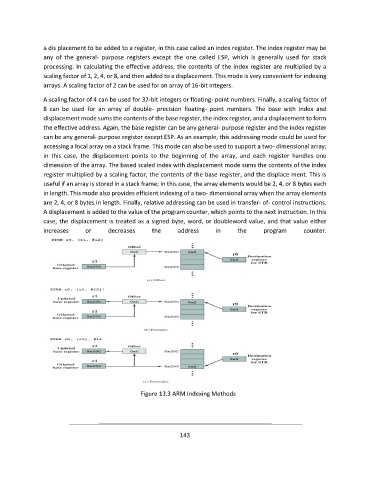
                                                Figure 13.3 ARM Indexing Methods


                                                             143

