


Page 141 - Handout of Computer Architecture (1)..
P. 141
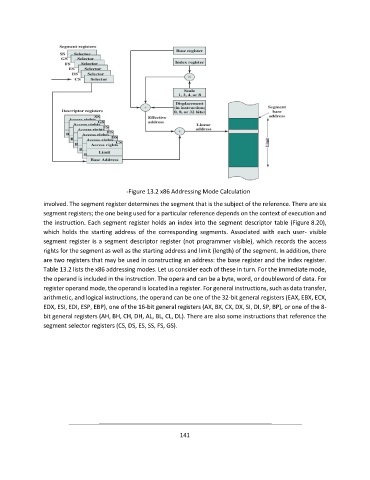
-Figure 13.2 x86 Addressing Mode Calculation

               involved. The segment register determines the segment that is the subject of the reference. There are six
               segment registers; the one being used for a particular reference depends on the context of execution and
               the instruction. Each segment register holds an index into the segment descriptor table (Figure 8.20),
               which  holds  the  starting  address  of  the  corresponding  segments.  Associated  with  each  user-  visible
               segment register is a segment descriptor register (not programmer visible), which records the access
               rights for the segment as well as the starting address and limit (length) of the segment. In addition, there
               are two registers that may be used in constructing an address: the base register and the index register.
               Table 13.2 lists the x86 addressing modes. Let us consider each of these in turn. For the immediate mode,
               the operand is included in the instruction. The opera and can be a byte, word, or doubleword of data. For
               register operand mode, the operand is located in a register. For general instructions, such as data transfer,
               arithmetic, and logical instructions, the operand can be one of the 32-bit general registers (EAX, EBX, ECX,
               EDX, ESI, EDI, ESP, EBP), one of the 16-bit general registers (AX, BX, CX, DX, SI, DI, SP, BP), or one of the 8-
               bit general registers (AH, BH, CH, DH, AL, BL, CL, DL). There are also some instructions that reference the
               segment selector registers (CS, DS, ES, SS, FS, GS).


                                                             141

