


Page 139 - Handout of Computer Architecture (1)..
P. 139
latter case, if the length of the address field is K and the number of possible registers is N, then one
               instruction can reference any one of N areas of 2K words. indexing for indexing, the interpretation is
               typically the following: The address field references a main memory address, and the referenced register
               contains  a  positive  displacement  from  that  address.  Note  that  this  usage  is  just  the  opposite  of  the
               interpretation for base- register addressing. Of course, it is more than just a matter of user interpretation.
               Because the address field is considered to be a memory address in indexing, it generally contains more
               bits than an address field in a comparable base- register instruction. Also, we will see that there are some
               refinements to  indexing  that  would  not  be  as  useful  in  the  base-  register context.  Nevertheless,  the
               method of calculating the EA is the same for both base- register addressing and indexing, and in both
               cases the register reference is sometimes explicit and sometimes implicit (for different processor types).
               An important use of indexing is to provide an efficient mechanism for per forming iterative operations.
               Consider, for example, a list of numbers stored starting at location A. Suppose that we would like to add
               1 to each element on the list. We need to fetch each value, add 1 to it, and store it back. The sequence of
               effective addresses that we need is A, A + 1, A + 2, . . . , up to the last location on the list. With indexing,
               this is easily done. The value A is stored in the instruction’s address field, and the chosen register, called
               an index register, is initialized to 0. After each operation, the index register is incremented by 1. Because
               index registers are commonly used for such iterative tasks, it is typical that there is a need to increment
               or decrement the index register after each reference to it. Because this is such a common operation, some
               systems will auto matically do this as part of the same instruction cycle. This is known as autoindexing. If
               certain registers are devoted exclusively to indexing, then autoindexing can be invoked implicitly and
               automatically. If general- purpose registers are used, the auto index operation may need to be signaled
               by a bit in the instruction. Autoindexing using increment can be depicted as follows.

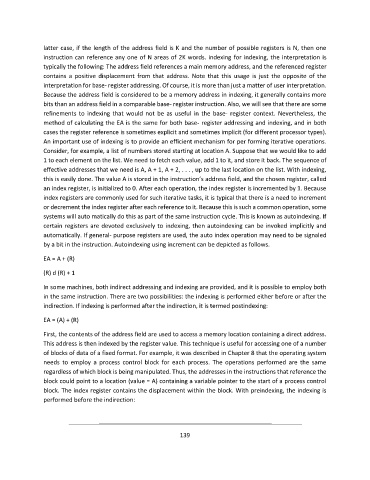
               EA = A + (R)

               (R) d (R) + 1

               In some machines, both indirect addressing and indexing are provided, and it is possible to employ both
               in the same instruction. There are two possibilities: the indexing is performed either before or after the
               indirection. If indexing is performed after the indirection, it is termed postindexing:

               EA = (A) + (R)

               First, the contents of the address field are used to access a memory location containing a direct address.
               This address is then indexed by the register value. This technique is useful for accessing one of a number
               of blocks of data of a fixed format. For example, it was described in Chapter 8 that the operating system
               needs  to  employ  a  process  control  block  for  each  process.  The  operations  performed  are  the  same
               regardless of which block is being manipulated. Thus, the addresses in the instructions that reference the
               block could point to a location (value = A) containing a variable pointer to the start of a process control
               block. The index register contains the displacement within the block. With preindexing, the indexing is
               performed before the indirection:


                                                             139

