


Page 136 - Handout of Computer Architecture (1)..
P. 136
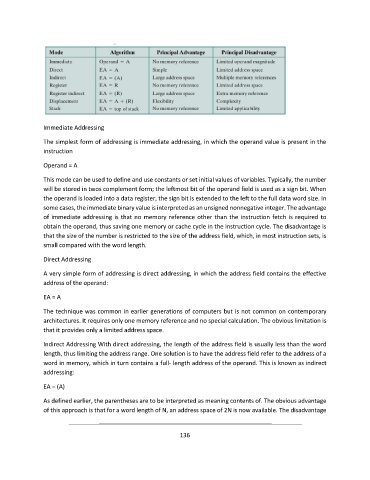
Immediate Addressing

               The simplest form of addressing is immediate addressing, in which the operand value is present in the
               instruction

               Operand = A
               This mode can be used to define and use constants or set initial values of variables. Typically, the number
               will be stored in twos complement form; the leftmost bit of the operand field is used as a sign bit. When
               the operand is loaded into a data register, the sign bit is extended to the left to the full data word size. In
               some cases, the immediate binary value is interpreted as an unsigned nonnegative integer. The advantage
               of immediate addressing is that no memory reference other than the instruction fetch is required to
               obtain the operand, thus saving one memory or cache cycle in the instruction cycle. The disadvantage is
               that the size of the number is restricted to the size of the address field, which, in most instruction sets, is
               small compared with the word length.

               Direct Addressing

               A very simple form of addressing is direct addressing, in which the address field contains the effective
               address of the operand:

               EA = A

               The technique was common in earlier generations of computers but is not common on contemporary
               architectures. It requires only one memory reference and no special calculation. The obvious limitation is
               that it provides only a limited address space.
               Indirect Addressing With direct addressing, the length of the address field is usually less than the word
               length, thus limiting the address range. One solution is to have the address field refer to the address of a
               word in memory, which in turn contains a full- length address of the operand. This is known as indirect
               addressing:

               EA = (A)

               As defined earlier, the parentheses are to be interpreted as meaning contents of. The obvious advantage
               of this approach is that for a word length of N, an address space of 2N is now available. The disadvantage


                                                             136

