


Page 140 - Handout of Computer Architecture (1)..
P. 140
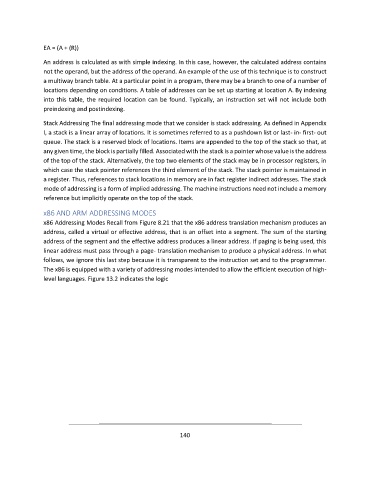
EA = (A + (R))

               An address is calculated as with simple indexing. In this case, however, the calculated address contains
               not the operand, but the address of the operand. An example of the use of this technique is to construct
               a multiway branch table. At a particular point in a program, there may be a branch to one of a number of
               locations depending on conditions. A table of addresses can be set up starting at location A. By indexing
               into this table, the required location can be found. Typically, an instruction set will not include both
               preindexing and postindexing.

               Stack Addressing The final addressing mode that we consider is stack addressing. As defined in Appendix
               I, a stack is a linear array of locations. It is sometimes referred to as a pushdown list or last- in- first- out
               queue. The stack is a reserved block of locations. Items are appended to the top of the stack so that, at
               any given time, the block is partially filled. Associated with the stack is a pointer whose value is the address
               of the top of the stack. Alternatively, the top two elements of the stack may be in processor registers, in
               which case the stack pointer references the third element of the stack. The stack pointer is maintained in
               a register. Thus, references to stack locations in memory are in fact register indirect addresses. The stack
               mode of addressing is a form of implied addressing. The machine instructions need not include a memory
               reference but implicitly operate on the top of the stack.

               x86 AND ARM ADDRESSING MODES
               x86 Addressing Modes Recall from Figure 8.21 that the x86 address translation mechanism produces an
               address, called a virtual or effective address, that is an offset into a segment. The sum of the starting
               address of the segment and the effective address produces a linear address. If paging is being used, this
               linear address must pass through a page- translation mechanism to produce a physical address. In what
               follows, we ignore this last step because it is transparent to the instruction set and to the programmer.
               The x86 is equipped with a variety of addressing modes intended to allow the efficient execution of high-
               level languages. Figure 13.2 indicates the logic


                                                             140

