


Page 142 - Handout of Computer Architecture (1)..
P. 142
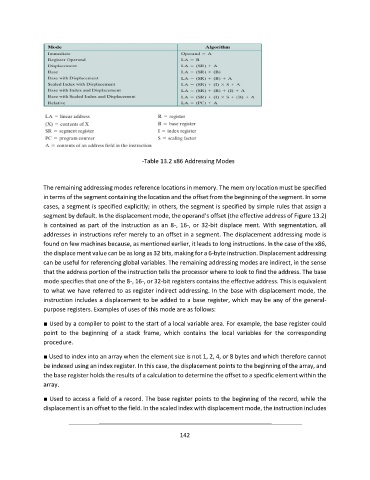
-Table 13.2 x86 Addressing Modes


               The remaining addressing modes reference locations in memory. The mem ory location must be specified
               in terms of the segment containing the location and the offset from the beginning of the segment. In some
               cases, a segment is specified explicitly; in others, the segment is specified by simple rules that assign a
               segment by default. In the displacement mode, the operand’s offset (the effective address of Figure 13.2)
               is  contained  as  part of  the  instruction  as  an  8-,  16-,  or 32-bit  displace  ment. With  segmentation,  all
               addresses in instructions refer merely to an offset in a segment. The displacement addressing mode is
               found on few machines because, as mentioned earlier, it leads to long instructions. In the case of the x86,
               the displace ment value can be as long as 32 bits, making for a 6-byte instruction. Displacement addressing
               can be useful for referencing global variables. The remaining addressing modes are indirect, in the sense
               that the address portion of the instruction tells the processor where to look to find the address. The base
               mode specifies that one of the 8-, 16-, or 32-bit registers contains the effective address. This is equivalent
               to what we have referred to as register indirect addressing. In the base with displacement mode, the
               instruction includes a displacement to be added to a base register, which may be any of the general-
               purpose registers. Examples of uses of this mode are as follows:

               ■ Used by a compiler to point to the start of a local variable area. For example, the base register could
               point  to  the  beginning  of  a  stack  frame,  which  contains  the  local  variables  for  the  corresponding
               procedure.

               ■ Used to index into an array when the element size is not 1, 2, 4, or 8 bytes and which therefore cannot
               be indexed using an index register. In this case, the displacement points to the beginning of the array, and
               the base register holds the results of a calculation to determine the offset to a specific element within the
               array.


               ■ Used to access a field of a record. The base register points to the beginning of the record, while the
               displacement is an offset to the field. In the scaled index with displacement mode, the instruction includes


                                                             142

