


Page 150 - Handout of Computer Architecture (1)..
P. 150
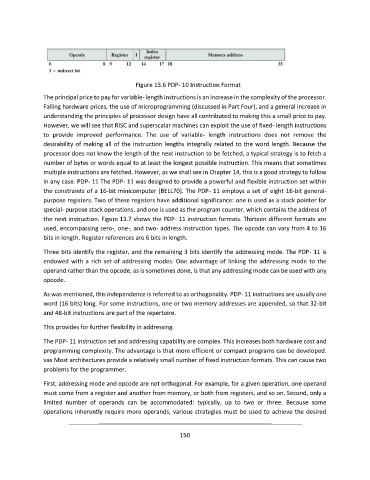
Figure 13.6 PDP- 10 Instruction Format

               The principal price to pay for variable- length instructions is an increase in the complexity of the processor.
               Falling hardware prices, the use of microprogramming (discussed in Part Four), and a general increase in
               understanding the principles of processor design have all contributed to making this a small price to pay.
               However, we will see that RISC and superscalar machines can exploit the use of fixed- length instructions
               to  provide  improved  performance.  The  use  of  variable-  length  instructions  does  not  remove  the
               desirability of making all of the instruction lengths integrally related to the word length. Because the
               processor does not know the length of the next instruction to be fetched, a typical strategy is to fetch a
               number of bytes or words equal to at least the longest possible instruction. This means that sometimes
               multiple instructions are fetched. However, as we shall see in Chapter 14, this is a good strategy to follow
               in any case. PDP- 11 The PDP- 11 was designed to provide a powerful and flexible instruction set within
               the constraints of a 16-bit minicomputer [BELL70]. The PDP- 11 employs a set of eight 16-bit general-
               purpose registers. Two of these registers have additional significance: one is used as a stack pointer for
               special- purpose stack operations, and one is used as the program counter, which contains the address of
               the next instruction. Figure 13.7 shows the PDP- 11 instruction formats. Thirteen different formats are
               used, encompassing zero-, one-, and two- address instruction types. The opcode can vary from 4 to 16
               bits in length. Register references are 6 bits in length.

               Three bits identify the register, and the remaining 3 bits identify the addressing mode. The PDP- 11 is
               endowed with a rich set of addressing modes. One advantage of linking the addressing mode to the
               operand rather than the opcode, as is sometimes done, is that any addressing mode can be used with any
               opcode.

               As was mentioned, this independence is referred to as orthogonality. PDP- 11 instructions are usually one
               word (16 bits) long. For some instructions, one or two memory addresses are appended, so that 32-bit
               and 48-bit instructions are part of the repertoire.

               This provides for further flexibility in addressing.

               The PDP- 11 instruction set and addressing capability are complex. This increases both hardware cost and
               programming complexity. The advantage is that more efficient or compact programs can be developed.
               vax Most architectures provide a relatively small number of fixed instruction formats. This can cause two
               problems for the programmer.
               First, addressing mode and opcode are not orthogonal. For example, for a given operation, one operand
               must come from a register and another from memory, or both from registers, and so on. Second, only a
               limited  number  of  operands  can  be  accommodated:  typically,  up  to  two  or  three.  Because  some
               operations inherently require more operands, various strategies must be used to achieve the desired


                                                             150

